
24/7 Emergency Tree Service in Santa Ana & Southern California
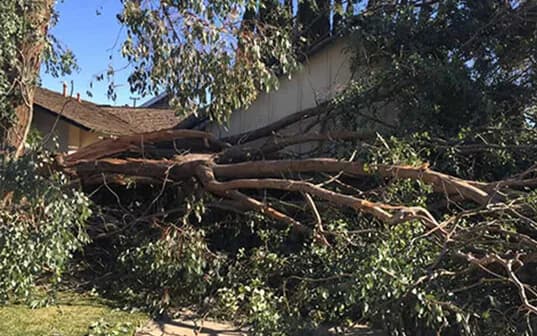
A tree on a house, a limb across a driveway, a trunk split at the union — we answer the phone at any hour, any day, from our base in Santa Ana, CA, across the five counties we cover.
Emergency Response
What counts as an emergency
A tree touching a structure, a power line, a vehicle or a walkway — and anything leaning that was not leaning yesterday. Those come out immediately. A dead tree standing clear of everything should still be dealt with, but it is not the same call, and you get told plainly which one you have.
Call 877-787-7363 at any hour. We answer 24 hours a day, 7 days a week.
Why trees come down, and what shows first
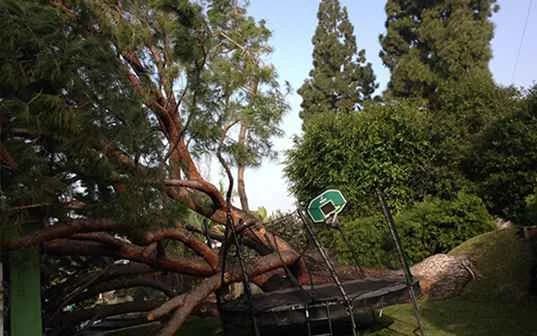
Almost nothing fails without warning. The wind gets the blame because it is the last thing to happen, but on nearly every failure we are called to, the reason was visible from the ground for a year beforehand.

Root rot — overwatered, poorly drained ground suffocates roots and lets fungi in. The sign is a thinning crown and fungal brackets at the base, not anything in the canopy
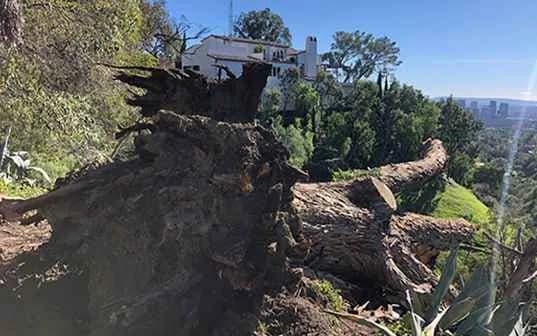
Saturated soil — ground that has taken weeks of rain stops holding the root plate, and the whole tree tips out intact rather than snapping
Santa Ana winds — a full canopy is a sail, and from September into spring is when it gets loaded against roots that have had no rain to soften the ground
Compacted or bone-dry soil — roots cannot spread through it, so a big crown ends up standing on a foundation far too small for it
Old age and internal decay — a hollowing trunk, deadwood in the upper crown and bark shedding in plates; the tree is losing structure faster than it can add it
A codominant stem with included bark — two trunks squeezing bark between them instead of joining. The commonest single failure point in a mature tree, and it splits at the union
One we cannot help with: we do not remove city trees. A tree standing in the public right of way belongs to the city, and the city's maintenance division handles it — including after a storm.
What to do in the first ten minutes, and what not to touch
Everything on the left of this list is free, and everything on the right is what puts people in hospital after a storm. The order matters more than the speed: on a storm site the first three decide whether anyone gets hurt, and the tree is still going to be there in an hour.
Get everyone back from it
Do or do not: Do firstAssume any line is live and stay at least 100 feet away — that is Southern California Edison's own figure. Current spreads outward through the ground around a downed conductor, so if you are already close, shuffle out with your feet together and on the ground rather than taking strides.
Call 911 before you call anyone
Do or do not: Do firstSCE's instruction is to call 911 and tell the operator it is an electrical emergency. For an object caught in a line with nobody hurt, SCE takes it directly on 1-800-611-1911. We are the call after those two, never before them.
Stay in the car if a line is on it
Do or do not: Do firstThe ground around the vehicle may be energised. Stay inside, call 911, wave people off. The only reason to get out is fire — and then you jump clear without touching the car and the ground at the same moment, land with both feet together, and shuffle away.
Photograph it before anything moves
Do or do not: DoThe California Department of Insurance tells claimants to take pictures and keep records of every clean-up and repair cost, and to make temporary repairs that stop further damage. An adjuster who never sees the tree where it landed has only your word for it.
Call the city if it is a street tree
Do or do not: DoA tree in the public right of way belongs to your city, and so does a tree blocking a public street. Call your city's Public Works line — in Santa Ana, our home base, it is (714) 647-3380, the same number outside office hours, which is the part nobody knows.
Do not cut anything under tension
Do or do not: NeverA storm-thrown trunk holds load in ways that are invisible from outside. Cut the tension side and the log drops or swings; cut the compression side and the bar pins. OSHA calls a bent, loaded sapling a spring pole, and one releases with enough force to kill at small diameters.
Do not fell a leaning tree yourself
Do or do not: NeverA forward-leaning or decayed trunk is the textbook setup for a barber chair — the butt splits upward and comes back at whoever is holding the saw. The CDC counts around 36,000 chainsaw injuries a year in US emergency departments and says the risk rises specifically after a storm.
Do not assume a dead line stays dead
Do or do not: NeverUtility circuits reclose automatically, so a conductor that went quiet can come back live with no warning at all. The rule Cal/OSHA sets for our own crews is to treat every line as energised with potentially fatal voltages, and it is the right rule for a homeowner too.
We do not publish a response time, and the reason is in the regulations rather than in modesty. Cal/OSHA Title 8, section 2951(f) bars line-clearance tree work in adverse weather, with winds over 40 mph — or over 30 mph where material is being handled — counting as hazardous conditions, and ANSI Z133 bars arboricultural work near energised lines in adverse weather outright. Anyone promising to be in your tree within thirty minutes of a Santa Ana wind event is promising something the safety standards do not permit. What happens immediately is the phone being answered, the triage above, and a straight answer about who to call first.
Does homeowners insurance cover emergency tree removal?
It depends on what brought the tree down and what it landed on — not on how much damage it did. Nearly every policy works the same way: a named peril that damages something the policy insures is the case that pays. A tree that fell on nothing generally is not.
| Cause of the tree falling | Where it landed | Removal covered? |
|---|---|---|
| Storm, hail or ice | On the home or a structure | Usually |
| Fire, lightning or impact† | On the home or a structure | Usually |
| Fire, lightning or impact† | On a lawn or open ground | Usually |
| Storm, hail or ice | On a lawn or open ground | Usually not |
| Flood or earthquake | Anywhere on the property | Usually not |
| Rot, disease or age | Anywhere on the property | Usually not |
† Fire, lightning, explosion, riot, aircraft, vehicles not owned by you, vandalism or theft — the perils a standard policy names.
Two things this table cannot tell you. Every policy caps what it pays toward tree removal, and the standard form language is a few hundred dollars per tree rather than the few thousand people expect. And a tree that was visibly dead or rotting before it fell is the case an insurer is most likely to decline, on the grounds that it was maintenance. Photograph everything before anything is moved, and call your own insurer — we are a tree service, not your adjuster.
What an emergency call actually covers
The first visit is about making the property safe, not about finishing the job. Those are two different pieces of work and on a storm site they are usually two different days.
Call any hourMake-safe, first
Whatever is moving gets stabilized and whatever is loose comes down. Access to doors, driveways and walkways is opened back up. Storm damage is triaged before it is tidied, and the full tree removal follows in daylight once nobody is standing under it.
Trees on a structure
A trunk across a roof is holding load in ways that are not obvious from underneath. It comes off in sections with the weight taken before each cut, rather than dragged — which is how a repairable roof becomes a replaced one.
Hangers and partial failures
A limb torn out but caught in the canopy is the most dangerous thing on a storm site: it is already loose, already loaded, and it will come down at a time nobody chooses.
Crane work at short notice
Our 75-foot boom trucks are ours rather than sub-hired, and where the lift needs a crane we bring one in and coordinate it rather than handing you a second contractor to chase.
Access and driveway clearing
Getting cars out, getting a driveway open and getting a street passable often matters more in the first hour than the tree does. That work happens first wherever it is needed, before anything is tidied.
Full tree removal and clean-up after
The fallen tree cut up, chipped and hauled, the trees left standing assessed properly in daylight, and anything still outstanding priced as ordinary tree care rather than at emergency urgency.
Why call Supreme Tree Experts for emergency tree service
We answer the phone 24 hours a day, 7 days a week. We ask what the tree is touching, whether anyone is near it, and whether a power line is involved. Line contact goes to the utility first. We do not promise a response time, because safety rules limit work in high winds.
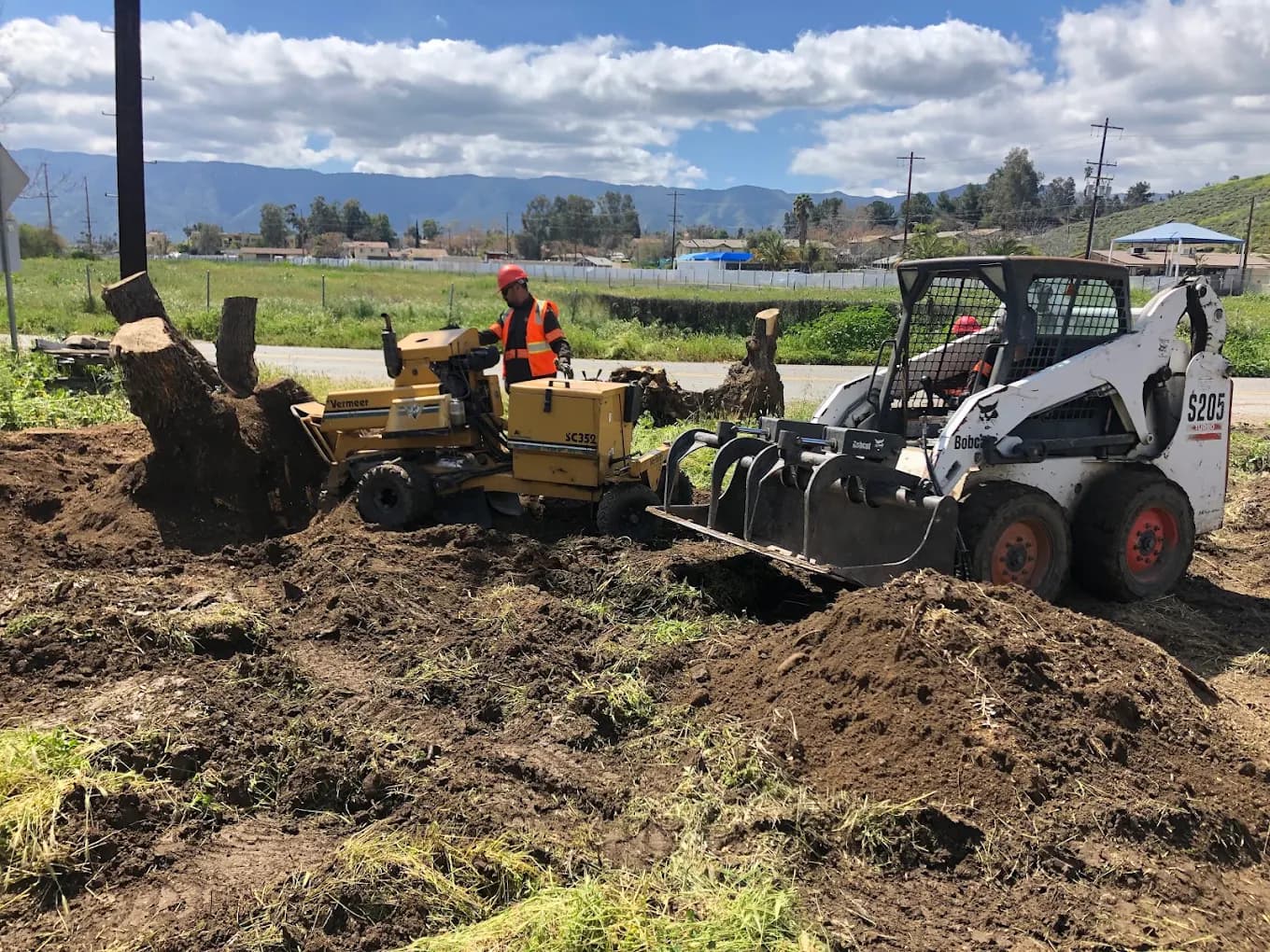
The first visit makes the property safe. The crew releases tension in a set order rather than cutting into it. Doors, driveways and walkways are opened back up. Debris is chipped and hauled. The rest is assessed in daylight and priced as normal work.
ISA Certified Arborist
Work runs under an ISA Certified Arborist. Once the site is safe, the arborist assesses the trees still standing in daylight before more work is priced.
Licensed, Bonded & Insured
CA license #1002853 covers C-27 Landscaping and C-61/D-49 Tree Service. We are bonded, carry general liability, and every employee has workers' comp for storm-site risk.
Southern California Since 1985
We have handled storm damage across Southern California since 1985. We know the dry wind season from September to May and soaked winter ground.
Our Own Equipment
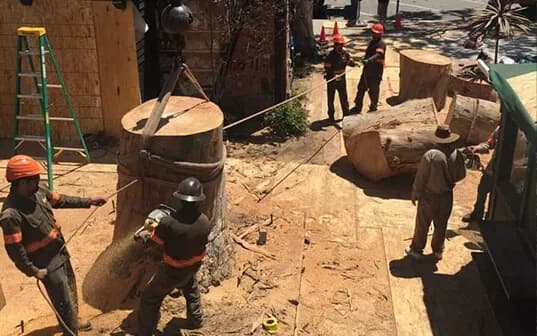
We own our 75-ft boom trucks rather than hiring them in. Our chippers and haulers clear storm debris on the same visit.
How an emergency call runs
- 01.
Called, at any hour
You reach us day or night. We ask what the tree is touching, whether anyone is near it and whether a line is involved — that decides how fast we come and with what.
- 24 hours a day, 7 days a week
- Line contact goes to the utility first
- 02.
Made safe
The crew stabilizes what is moving, releases tension in a controlled sequence rather than cutting into it, and clears access to doors, driveways and walkways. That is what an emergency call buys — the rest is a job, and a job happens in daylight.
- Tension released in sequence
- Access opened back up
- 03.
Cleared, then quoted in daylight
Debris is chipped and hauled, the remaining tree is assessed properly in daylight, and anything still to do is priced as normal work rather than as an emergency.
- Debris hauled the same visit
- Follow-up priced as normal work
What a crew should be doing on a storm site
Anyone with a chainsaw can cut up a fallen tree, and after a wind event plenty of people will knock on the door offering to. These are the things that separate a crew from a truck, whoever you end up calling.
Nobody within 10 feet of a power line
Only trained, qualified workers may work inside 10 feet of an energized line — no exceptions, and no favors. That is the Cal/OSHA line, and above 600 volts it narrows further to qualified line-clearance tree trimmers only. Anyone who offers to just move it off the wire for you is telling you they should not be there.
Saddles, lines and full protective equipment
Tree saddles and safety lines for anyone off the ground, hard hats, eye protection and ear protection for everyone on it. On a storm site with loaded wood in the canopy, this is the difference between a job and a gamble.
Traffic and pedestrians controlled
Cones, a spotter and a closed drop zone before the first cut. Storm work draws neighbors out to watch, and the exclusion zone exists for them as much as for the crew.
Nothing dropped that can be lowered
Large limbs lowered on ropes and rigging rather than cut free and allowed to fall. On a property that has already taken damage, the second round of it usually comes from the clean-up.
Proof of insurance, before work starts
Ask for the license number and check it on the CSLB site — it takes a minute even in an emergency. Storm chasing is a real trade, and an uninsured crew injured on your property becomes your problem rather than theirs.
Where we work across Southern California
5 counties — Orange, Los Angeles, San Diego, Ventura and Santa Barbara — worked by crews running out of Santa Ana. These 7 areas are where most of it happens. Call 877-787-7363 if you are not sure whether your address falls inside them.
See every town we serveRecent emergency tree service jobs
Real photos and videos from our own job sites. Tap any one to see it full size.
Real reviews, straight from our Google profile
Every word below was written by a customer on Google, not by us. Long reviews are shortened to fit the card — never reworded — and the full list is one click away.
“Great pricing & service. Highly competent with tricky jobs. We have used them for more than 10 years.”
Melanie Butler
Local Guide
“We got bids from five contractors. After I talked to them all and checked out their licenses and work, we decided to go with Supreme. … The job took a day and a half, and when they were done, they left the place immaculate.”
Hank Shaeffer
“Great tree trimmers! I’ve used Supreme Tree Experts twice to trim the palm trees in my yard. … The guys who come out are quick thorough, and clean. And very careful not to damage property.”
Emilie Pacheco
“These guys have worked on my property 3 times now. They are always on time and do a fantastic job. I highly recommend them!”
Ray Thompson
“After soliciting several quotes on some difficult yard work, we chose Supreme because of their licensed Arborist Temis … The crew was extremely hard working and we couldn’t believe their continuous work ethic on one of the hottest days of the year.”
Gary Brown
Local Guide
“Had them take out some tall eucalyptus trees on my lot in Hollywood. Great service. Fast, friendly and professional.”
Kirk Lee
Local Guide
Emergency tree service questions from Southern California
Response times, power lines, what it costs and the paperwork a claim needs — six the sections above do not already answer. If yours is not here, call 877-787-7363 and ask.
Yes, 24/7. Crews run out of our Santa Ana yard around the clock. Call 877-787-7363 — an emergency is a phone call rather than a form, and nothing on this website reaches anyone faster than the phone does.
We do not publish a response time, and you should be wary of anyone who does. After a Santa Ana wind event the calls stack up across every city we cover at the same moment, and the honest answer depends on where crews already are and what your tree is currently touching. Call and you will be told what is realistic for your address at that moment rather than a number that sounds good on a website.
Not by more than 10%, once an emergency has been declared. California Penal Code 396 caps increases on repair, reconstruction and emergency cleanup services after a declared emergency, and for reconstruction and emergency cleanup that protection runs 180 days rather than the usual 30. Breaking it carries up to a year in county jail and a fine of up to $10,000. Separately, and worth following whoever you call: the CSLB tells homeowners never to pay more than 10% down or $1,000, whichever is less, and to check the license number at cslb.ca.gov before anyone starts work.
It is quoted on the work in front of us, the same as any other job — the difference is the hour rather than the method. Ask when you call and we will be straight with you about where the number lands before a crew rolls.
We give you what a claim needs; we do not file it for you. That means an itemized invoice describing the work rather than a single figure, and photographs of the tree and the damage before anything is moved. Adjusters ask for both. What we are not is your adjuster or your advocate — the claim is a conversation between you and your insurer.
The tree, yes — everything it broke on the way down, it depends. Wood is chipped and hauled off the property in our own trucks — wherever we work, it leaves with the crew rather than going out with your green waste — and the site is left clear rather than merely safe. Fence panels, roof material, gutters and anything else the tree took with it are not tree debris, so say what is on the ground when you call and you will get a straight answer about what goes and what stays.