
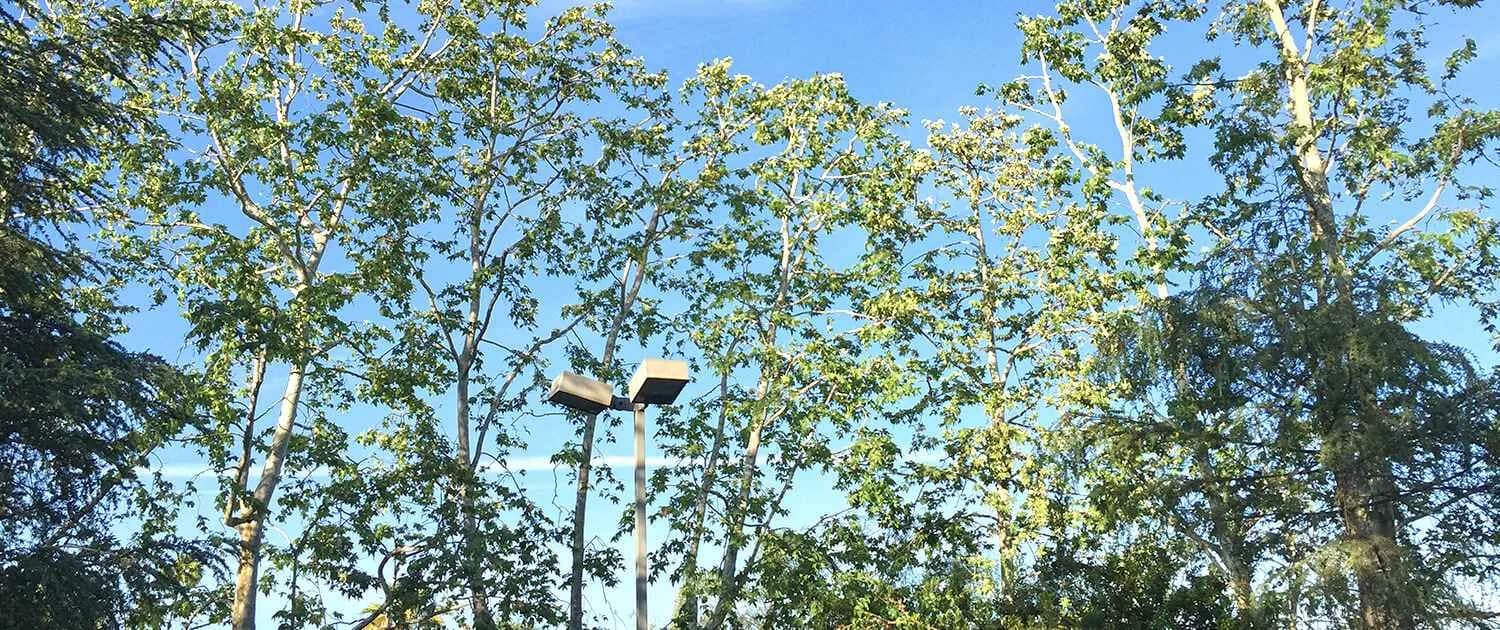
Estate Tree Care in Santa Ana & Southern California
Mature and specimen trees on estate grounds, from our base in Santa Ana, CA across the five counties we cover, worked by crews used to gated access, finished grounds and a property that has to look untouched at five o'clock.
Estate Grounds
What estate tree care asks that a yard does not
Protection of everything the tree is standing in. Irrigation heads, decomposed granite, pool coping, cut-stone paving and turf that took a season to establish are all inside the drop zone of a mature specimen. On an estate the cost of the tree work is rarely the number that matters — the cost of repairing what got driven over is.
The property should look better at five o'clock than it did at eight.
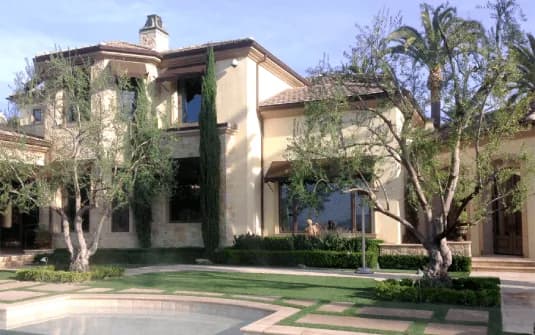
Why estate grounds need a standing arrangement
The defining fact about most estate properties is that nobody is standing under the trees every day. Everything below follows from that: a problem on a lived-in property gets noticed in a week, and the same problem on an estate gets noticed when somebody visits.
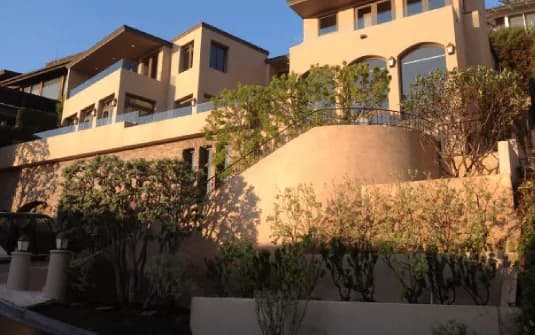
Nobody is watching the trees day to day — a split union, a lifting root plate or a dying crown goes unreported for months on a property visited occasionally
Neglect is a liability, and an absent owner is still the owner — a failure from a defect that was visible and untreated is judged on whether it could have been seen, not on whether anybody was there to see it
A neighbor can compel you to cut — an encroaching limb can be actioned in California whether or not it has done any damage yet, and on an estate boundary that conversation arrives by letter
Specimen trees are irreplaceable on any useful timescale — the mature trees are the part of the grounds that money cannot install, and losing one to something preventable is permanent
Grounds staff and gardeners are not arborists — a gardener will keep the beds immaculate and walk under a hanging limb every day without registering it
The property is judged at a glance — by a buyer, a valuer, an insurer or a board, and on older streets the trees are the first thing any of them look at
None of this needs the owner present. A standing arrangement means the trees are looked at on a cycle and you hear about a problem in a report rather than in a phone call from a neighbor.
The 8 things that actually damage a mature specimen
Almost nothing on this list is done by weather. Every one of them is ordinary care of finished grounds — planting, watering, paving, mulching, feeding — carried out by somebody who meant well, and most take years to surface. On a property where nobody is standing under the trees, years is long enough for all of them.
Planted too deep, long before you owned it
Where it comes from: Already doneA tree set below its root flare grows roots that circle the trunk and eventually strangle it. Colorado State's extension service calls girdling roots from deep planting the most common cause of tree decline and death in the landscape — and on estate grounds the tree was almost always planted by somebody else, decades ago.
Soil compacted by everything that crosses it
Where it comes from: Done by useVehicles, stored materials and the same route walked every week close the large pores that hold air. Purdue's extension measures compacted soil down to as little as 2 to 4 percent of the oxygen a root system needs, and Colorado State calls compaction the most common inciting factor in the decline process — the thing that starts it rather than the thing that finishes it.
A grade raised around an existing trunk
Where it comes from: Done by landscapingNew soil brought in to level a lawn, build a planter or set a patio buries the flare and smothers roots that were already at the depth they wanted. Purdue names raising the grade around existing trees one of the most common causes of decline on a construction site, and a landscape renovation is a construction site.
A trench for irrigation, lighting or a pool
Where it comes from: Done by contractorsUniversity guidance is to cut no closer to a trunk than three times its diameter, and preferably five — so a 20-inch trunk wants five feet of clearance at the very least. UC IPM's warning is the one that matters to an absent owner: construction damage may not become apparent until several years after the injury. The trencher is long gone by the time the crown thins.
Mulch piled against the trunk
Where it comes from: Done by maintenanceTwo to four inches, spread wide, and pulled back far enough that the root flare is still visible. Heaped against the trunk it holds moisture on bark not built to stay wet. Illinois Extension puts over-mulching and mulch against the trunk among the most common causes of tree decline, and the ANSI A300 tree care standards are unusually flat about it — mulch is not to be placed against trunks or over root flares.
Fertilizer used in place of a diagnosis
Where it comes from: Done by habitUC IPM's position is that most established trees and shrubs do not require routine fertilizer, and Maryland's extension puts it more bluntly still: fertilizer is not a remedy for landscape problems. A tree declining from compaction, a buried flare or severed roots does not improve because it was fed — it declines on a slightly better diet.
Deep root feeding, sold as reaching what surface feeding cannot
Where it comes from: Done by contractorsInjection has real uses — getting past turf roots, keeping product out of runoff — and it is done at four to eight inches, which is where the feeder roots are. What it does not do is reach deeper roots, because Oregon State puts most of a tree's feeder roots in the top 12 inches of soil, and three extension services report surface-applied nitrogen performing as well as injected. Two firms competing for this work in Santa Ana, CA, where we are based, sell it on the claim universities do not support.
Cables installed once and never looked at again
Where it comes from: Done by nobodyHardware ages, trunks grow around it, and a cable that was right in 2009 can be carrying load into wood that has changed shape underneath it. On a property bought with cables already in the trees, nobody has inherited the job of checking them — which is the whole problem, and the standards are clear about whose job it is.
Seven of these eight are done by people looking after the place, not by people neglecting it, which is exactly why an owner who is not on site never hears about them — nobody files a report about mulch. The eighth is worth knowing in its own right if you bought a property with hardware already in the trees: the ANSI A300 tree care standards require that an owner be told a support system needs periodic inspection, and they put the scheduling of those inspections on the owner rather than on whoever installed it. What no standard can fix for you is the interval, because species, condition, weather and the hardware itself all move it. The practical figures come from the universities instead: UMass puts it at inspecting annually and expecting to replace hardware after seven to ten years.
Does your insurance replace a mature tree?
Almost never, and the reason is a list most owners have never read. A standard homeowners policy covers trees, shrubs, plants and lawns against seven named perils, pays a small fraction of the dwelling limit for all of them together, and caps what it pays for any one plant. On a property where the trees are a real part of the value, the gap between that cap and the tree is the whole point.
| What happens | What a standard policy does about it | Paid for? |
|---|---|---|
| A tree comes down and damages the house | The damage to the structure is the dwelling coverage answering, not the tree coverage — those are two different parts of the policy and only one of them is generous | Yes |
| The tree itself, lost to wind | Windstorm is not among the perils named for trees and shrubs on any edition of the standard form — not the 2000, not the 2011, not the current 2022 | No |
| The tree itself, lost to fire, lightning or a vehicle | Fire or lightning, explosion, riot, aircraft, a vehicle not owned by a resident, vandalism and theft are the seven perils that do apply | Yes |
| The full replacement value of a mature specimen | Capped. Five percent of the dwelling limit covers all the planting together, and a per-plant cap sits inside that — $500 on the older forms, $1,500 on the 2022 one | No |
| Clearing a tree that came down and hit nothing | Debris removal pays where the tree damaged a covered structure, blocked a driveway against a road-registered vehicle, or blocked a ramp for a disabled person. A tree lying on the lawn is none of those | No |
| Clearing a tree that came down across the driveway | The same clause, and this is the limb of it that pays — the aggregate runs $1,000 on the older forms and $3,000 on the 2022 one | Yes |
Figures are from the standard industry homeowners form. The California Department of Insurance's own consumer guide still quotes the older $500 per-plant sub-limit, so both numbers are in circulation and yours is whichever your policy says.
Which is why the number that matters is not the policy's — it is the appraisal's. A mature specimen on estate grounds is routinely worth many multiples of a per-plant cap, and California does not confine recovery to the fall in a property's market value: under Heninger v. Dunn the cost of restoring what was there can exceed the diminution in value where the owner has a reason personal to them for restoring it. Appraisals are written against the CTLA Guide for Plant Appraisal, now in its tenth edition, which is the recognised industry reference rather than a standard — a distinction the ISA itself is careful to make. And where somebody else damages the tree, California Civil Code 3346 is not insurance at all: doubling the actual damages is the floor a court must apply, and trebling is available where the trespass was wilful and malicious. Every one of those routes depends on there being a record of what the tree was beforehand, which an absent owner only has if somebody was writing it down. General information, not legal advice — your own attorney or insurer answers for your property.
How much does estate tree care cost in Southern California?
Per property and per visit after somebody has walked the grounds, starting at the $600 tree-services minimum — not per tree from a description. On an estate the brush pile is a poor guide to the invoice: the expensive hours are usually the ones spent on a single specimen, and the cheap ones fill the chipper.
The 6 things estate tree care is priced on
The inventory, not the tree in front of you
How many trees there are and how many of them are specimens rather than replaceable stock. The quote is written against a list made on the walk across the property, tree by tree, so the grounds can be approved in priority order instead of as one figure.
Specimen work is priced on skill, not on volume
Cabling a union, bracing a limb, restoring a crown that was cut badly a decade ago. Almost nothing leaves the property and it is the most expensive hour on the invoice — which is the opposite of what the size of the brush pile suggests.
Protecting the ground before anything comes down
Mats and boards across paving and turf, covers over pool coping, irrigation heads marked or lifted. It is a real line on an estate quote and it does not appear on a residential one at all.
How far the work is from where a truck can stand
Not whether a machine reaches the property — that is settled before a date is set — but how far it then is to each tree. On acreage every limb cut makes that trip, and 400 feet of it is a different day from 40.
Whether anything sits underneath the cut
A limb that can be dropped costs a fraction of one that has to be lowered on ropes. Estate lots tend to have generous setbacks and targets everywhere inside them all the same — a pool, a pool house, a wall of glass, a neighbor's fence line — and rigging a piece out over one of them is the slowest hour of the day.
Everything on the grounds that is not a tree
Hedge lines, palms, an orchard, roses down a drive. Quoted together they are one mobilization of one crew to one address; quoted separately they are four, and the travel is paid for four times.
The line worth comparing between two estate quotes is the protection, not the cutting. A quote that does not price mats, boards and covers has not removed that cost — it has moved it to whoever repairs the driveway afterward. The walk and the written scope cost nothing either way.
What estate tree care covers beyond cutting
Tree pruning is the visible half and rarely the expensive one. On grounds where the trees are the asset, most of a program is about keeping specimens alive and stable rather than about keeping them tidy.
Book a free site walkCyclical tree pruning and deadwooding
Specimens worked on a rotation set per tree rather than per property, with dead and broken wood out of the canopy each visit. On mature trees the aim is to change the outline as little as possible while removing what is failing.
Cabling and bracing
Hardware supporting a union worth keeping — a codominant stem on a 90-year-old specimen is worth holding together rather than reducing away. Installed once and then inspected on the cycle, because hardware ages too.
Mulching and root zone care
A proper mulch ring keeps mowers off the root flare, holds moisture and feeds the soil as it breaks down. On estate grounds the commonest injury to a mature tree is repeated damage at the base from equipment.
Soil and nutrition
Compacted, irrigated, heavily fertilized lawn soil is not what a mature specimen evolved in. Where a tree is declining without an obvious cause, what is happening below grade is usually the place to look first.
Root management
Roots lifting hardscape, entering drains or running under a footing. Which root can be cut and how far out is an arborist's decision, because the wrong one destabilizes the specimen standing on it.
Storm preparation and response
The cycle scheduled ahead of the Santa Ana wind season, and cover for what happens anyway. On a property nobody is living at, knowing somebody will attend is most of the value.
Why estate owners trust Supreme Tree Experts for estate tree care
On an estate, the repair bill often matters more than the tree work. Before equipment moves, mats and boards go down over paving and turf. Irrigation is located first. Where a machine does not belong, the crew rigs limbs down by hand on ropes.
An arborist walks the grounds with the owner or estate manager and records the specimen trees. Before the crew leaves, the protection comes up and the beds are blown clean. The property is walked again, so the grounds look untouched by the end of the day.
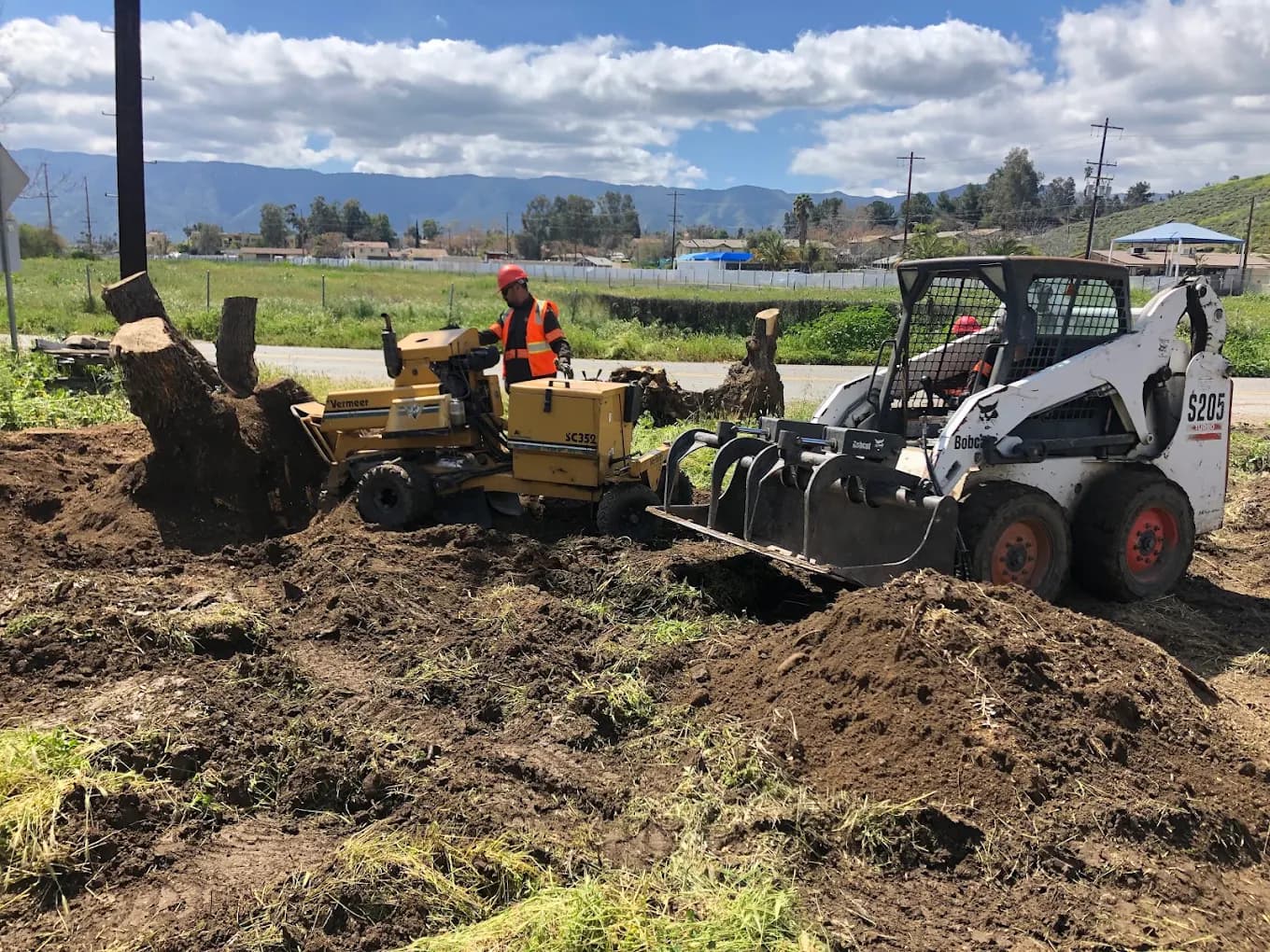
ISA Certified Arborist
An ISA Certified Arborist oversees your grounds. The arborist records each specimen, checks cabled unions and decides which roots can be cut safely.
Licensed, Bonded & Insured
CA license #1002853 covers C-27 Landscaping and C-61/D-49 Tree Service. We are bonded, carry general liability, and every employee has workers' comp on grounds with costly hardscape.
Southern California Since 1985
We have cared for mature trees across Southern California since 1985. Storm prep is timed ahead of the wind season, even when nobody is home.
Our Own Equipment
Our own 75-ft boom trucks and chippers stay where the ground can take them. Our haulers carry away every piece of debris.
How estate tree care is run
- 01.
Walked with whoever runs the grounds
An arborist drives out, walks the property with the owner or the estate manager, records the specimen trees and agrees what the grounds can and cannot take.
- Free on-site walk
- Access and loadings checked first
- 02.
Protected, then worked
Ground protection goes down before equipment moves, irrigation is located, and the crew works to the plan — hand-rigging wherever a machine should not go.
- Turf and hardscape protected
- Hand-rigged where access is tight
- 03.
Left as it was found
Debris is chipped and hauled, the ground protection comes up, beds are blown clean, and the property is walked again before the crew leaves.
- Grounds walked before sign-off
- Full clean-up included
Running grounds you are not living on
Five things worth having in place before the first visit, if the property is a second home, a rental, a trust asset or simply somewhere you are not most weeks. None of them are about trees specifically, and all of them are why estate work goes wrong.
One point of contact who can approve work
An estate manager, a property manager or you. What stalls jobs is not the quote — it is a crew standing at a gate while somebody works out who is allowed to say yes to an unexpected $900 of deadwooding.
Access sorted before it is needed
Gate codes, key holders, alarm contacts and which entrance takes a boom truck. Sorted once, this is a non-issue; sorted on the morning of a storm, it costs hours nobody has.
Photographs each visit, not just an invoice
On a property you are not standing on, photographs of what was done and what was noted are the only record you have. Ask for them as standard rather than when something goes wrong.
A written note of what is changing
Which trees are declining, which unions are being watched, what is scheduled next cycle. A tree failing is rarely a surprise to anyone who was looking — the question is whether the looking got written down.
Proof of insurance on file, before the first visit
License number, general liability, workers' compensation. On grounds with mature specimens and expensive hardscape the exposure is real, and an absent owner is the least well-placed person to discover a problem late.
Where we work across Southern California
5 counties — Orange, Los Angeles, San Diego, Ventura and Santa Barbara — worked by crews running out of Santa Ana. These 7 areas are where most of it happens. Call 877-787-7363 if you are not sure whether your address falls inside them.
See every town we serveRecent estate tree care jobs
Real photos and videos from our own job sites. Tap any one to see it full size.
Real reviews, straight from our Google profile
Every word below was written by a customer on Google, not by us. Long reviews are shortened to fit the card — never reworded — and the full list is one click away.
“Great pricing & service. Highly competent with tricky jobs. We have used them for more than 10 years.”
Melanie Butler
Local Guide
“We got bids from five contractors. After I talked to them all and checked out their licenses and work, we decided to go with Supreme. … The job took a day and a half, and when they were done, they left the place immaculate.”
Hank Shaeffer
“Great tree trimmers! I’ve used Supreme Tree Experts twice to trim the palm trees in my yard. … The guys who come out are quick thorough, and clean. And very careful not to damage property.”
Emilie Pacheco
“These guys have worked on my property 3 times now. They are always on time and do a fantastic job. I highly recommend them!”
Ray Thompson
“After soliciting several quotes on some difficult yard work, we chose Supreme because of their licensed Arborist Temis … The crew was extremely hard working and we couldn’t believe their continuous work ethic on one of the hottest days of the year.”
Gary Brown
Local Guide
“Had them take out some tall eucalyptus trees on my lot in Hollywood. Great service. Fast, friendly and professional.”
Kirk Lee
Local Guide
Estate tree care questions from property owners
Liability while you are away, encroaching limbs, restricted access and who turns up each visit — six the sections above do not already answer. If yours is not here, call 877-787-7363 and ask.
No — and that is the point worth understanding. Liability turns on the condition of the tree beforehand, not on whether anybody was home. A healthy tree brought down by a storm is normally each owner's own insurer. A tree that was dead, diseased or visibly failing before it went is the owner's problem, and "nobody was there to notice" is closer to the argument against you than for you. On a property you are not living at, a documented inspection cycle is the only thing that makes the difference.
Any property where the trees are part of the value of the place — established grounds, hillside lots, long driveways, and gardens where a single mature specimen would be expensive and slow to replace. Acreage matters less than what is growing on it.
In practice, usually yes — and they can generally cut it themselves regardless. In California a neighbor may trim what crosses onto their land back to the boundary at their own expense, without asking. Where an encroachment is causing an actual nuisance, they can press the owner to deal with it even if nothing has been damaged yet. The reason to act first is not the law but the cut: a limb taken off arbitrarily at a property line is the cut most likely to disfigure or destabilize the tree, and it is your tree.
By specifying the report before the work rather than inspecting the tree after it. The ANSI A300 tree care standards set out what a scope of work should specify, and four of its six items are about the reporting rather than the cutting: the level and detail of the assessment, the type of report, the time frame for reporting, and who the report is presented to. All four can be agreed in writing before a crew is ever booked onto the property. The standard is written for exactly this — it names property owners and property managers among the people it is intended for, alongside arborists and utilities. Ask for photographs of each specimen before and after as well, and an absent owner finishes with a better record of the work than an owner who stood and watched it and wrote nothing down.
Yes, and that is most of the value. An arborist who saw the property last year assesses this year's growth against what the trees were doing then, rather than starting from scratch every visit.
Yes. Estate work is quoted the same way whether the instruction comes from an owner or a manager, and commercial tree service covers managed portfolios across Southern California.