
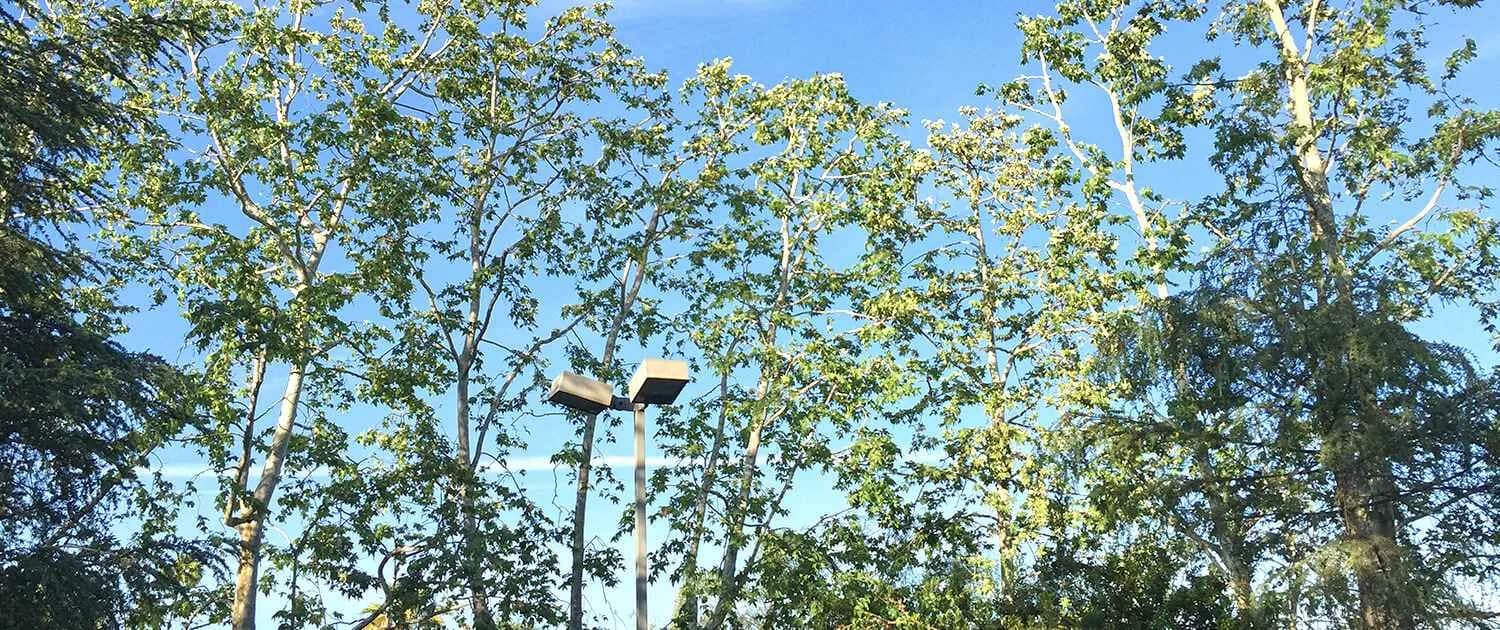
Tree Trimming & Pruning in Santa Ana & Southern California
Tree trimming and tree pruning are the same job under two names. Across the five Southern California counties we cover, from our base in Santa Ana, CA, it is cut to ANSI A300 by crews working under an ISA Certified Arborist — natural lacing, crown thinning and clearance work, and no topping at any price.
Tree Trimming & Pruning
What a tree trim removes
Dead wood, crossing limbs, weak unions, and enough interior growth to let wind move through the canopy instead of against it. Tree trimming and pruning are the same work — the words split along who is saying them, not along what the crew does — which is why this is one page rather than two.
We do not top trees. Not on request, and not at a discount.
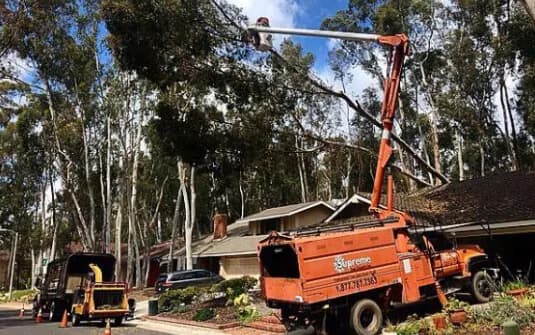
6 signs a tree is due a trim
The first two are safety and they do not wait for a season. The rest are the difference between a tree that is being maintained and one that is being left to sort itself out, and all six are visible from the ground without a ladder.
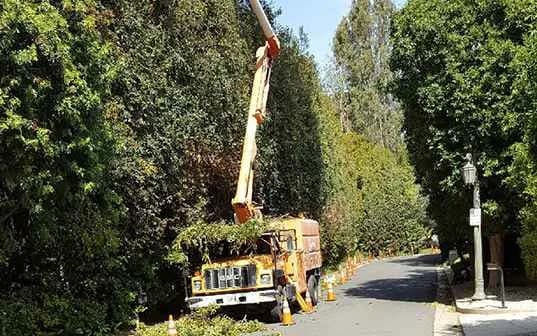
Branches are near a power line — call Southern California Edison before anyone else, and nobody should be up there in the meantime
Limbs are touching the house — rubbing strips bark, opens the tree to pathogens, and gives rodents a bridge onto the roof
There is dead or hanging wood in the canopy — a hanger is loose already; it is only a question of what is underneath when it comes down
Branches are crossing and rubbing each other — each rub is an open wound, and the one that loses will eventually tear out
The canopy has gone lopsided — weight that has all migrated to one side is weight the trunk is carrying off-center every time the wind blows
It has not been touched in 3 or more years — by then the cuts needed are bigger, the tree takes longer to close them, and the job costs more than three smaller ones would have
Two of these are worth acting on this week rather than this season: anything touching a power line, and anything already hanging. The rest keep until the right window, and in this climate that window is usually the dormant season rather than the middle of summer.
How often each common street tree is pruned
Our home city of Santa Ana, CA publishes a trim cycle for every species on its designated street tree list, and it runs from one year to five. Those intervals are set for a tree in a parkway rather than a back yard, but the species does not change when it crosses the sidewalk — which makes them the best published guide there is to what the same tree wants from you. Twelve of the twenty-three, and what sets each number.
African sumac
City trim cycle: Every yearRhus lancea is one of two species the city trims every single year. Fast growth, constant fine litter and suckers off the base — twelve months is already the limit of what holds its shape.
Peppermint tree
City trim cycle: Every yearAgonis flexuosa is the other annual. A weeping habit over a dense interior means it closes in on itself within a season, and the deadwood that builds inside it is invisible from the ground until it drops.
Queen palm
City trim cycle: Every yearSyagrus romanzoffiana is the only palm on the city's street list, in parkways as narrow as two and a half feet. Annual, because the fronds, the flower stalks and the fruit all arrive on the same schedule.
Jacaranda
City trim cycle: Every 2 yearsJacaranda mimosifolia is semi-evergreen, brittle where two leaders meet at a narrow angle, and it litters twice a year — flowers in spring, pods after. The two-year cycle is about structure as much as tidiness.
Chinese elm
City trim cycle: Every 2 yearsUlmus parvifolia puts on length quickly and forms included-bark unions where codominant stems meet. Two years catches those while the corrective cut is still small enough for the tree to close over.
Canary Island pine
City trim cycle: Every 2 yearsPinus canariensis sheds long needles and dies back in the interior continuously, and it gets tall enough that access starts deciding the job. Two years keeps the deadwood out before it comes down on its own.
Southern magnolia
City trim cycle: Every 3 yearsMagnolia grandiflora is dense, evergreen and slow enough to hold a shape between visits. Most of what comes off at three years is clearance and deadwood rather than thinning.
Coast live oak
City trim cycle: Every 4 yearsQuercus agrifolia is on a long cycle because it should be left alone between them. Native, structurally sound, and the species where over-pruning does the most harm for the least gain.
California sycamore
City trim cycle: Every 4 yearsPlatanus racemosa is one of three sycamores on the city's list and a reproductive host for the invasive shothole borer, which is established across Orange County. The interval is long; the blade sanitation between trees is not optional.
Camphor
City trim cycle: Every 4 yearsCinnamomum camphora needs an eight-foot parkway and four years between visits. Surface roots are what usually puts one on a work order, and that is a hardscape problem rather than a pruning one.
Crape myrtle
City trim cycle: Every 4 yearsLagerstroemia indica is the smallest tree on the list, planted in parkways down to two and a half feet. Four years — and the annual cutting back to knuckles it gets in other cities is topping, not pruning.
New Zealand Christmas
City trim cycle: Every 5 yearsMetrosideros excelsa is the longest interval the city uses. Slow, dense and salt-tolerant, it holds its form for five years with nothing but deadwood coming out of it.
Topping a public tree in our home city is unlawful — that is SAMC 33-190 — and the code defines the word precisely at SAMC 33-182: cutting limbs back to stubs larger than three inches in diameter within the tree's crown, to the point of removing the canopy and disfiguring the tree. It is a measurable line rather than an opinion, and it is the same one we hold on a private tree, where no ordinance reaches.
What a pruning cycle actually buys you
A tree on a cycle costs less per visit than the same tree left alone, because the cuts stay small enough for the tree to close over and no single visit has to undo three years of growth. Here, the reasons are not only about how it looks.
A tree that lives longer
Dead and diseased wood taken out before decay reaches the trunk, and weak unions corrected while the cuts are small enough for the tree to close over. Most tree failures were visible years before they happened.
Less to fail in a wind event
A thinned canopy lets Santa Ana wind move through it instead of pushing against it, and the over-extended limbs that tear out first are already gone. Storm damage is mostly deferred maintenance arriving at once.
Fewer pests and pathogens
Rubbing branches and torn stubs are open wounds, and open wounds are how boring insects and fungal pathogens get in. Clean cuts at the collar close; ragged ones stay open for years.
Light back where you want it
Thinning lets light through the canopy to the lawn, the beds and the windows underneath without taking the tree's shape away — which is what topping does instead, and permanently.
A property that reads as cared for
Mature trees in good shape are the part of a frontage that cannot be installed quickly, and a badly cut tree is visible from the street for years afterward. It is the cheapest thing on a property to get wrong in public.
Who clears a branch off a power line?
The utility maintains clearance on its own conductors, and everything past that is yours to arrange. Southern California Edison (SCE) asks to be notified before anyone works on a tree within 10 feet of its lines, and the assessment that follows costs nothing — which makes the phone call the first step rather than the last one.
| What the branch is near | Who maintains the clearance | Free to you? |
|---|---|---|
| SCE's own primary conductors | SCE — GO 95 Table 1, Case 13 sets an 18-inch minimum | Free |
| Any tree within 10 feet of an SCE line | SCE, once you notify them — they assess it and make the tree safe to work | Free |
| The service drop running to your house | Call SCE first — GO 95 asks for it to be kept clear where practicable | Free |
| Cable, phone and fibre lines | The utility that owns the line, not the electricity supplier | Free |
| The rest of the canopy, clear of every conductor | You, or the tree service you hire — ordinary tree work | You pay |
Whether a property sits in a CPUC High Fire-Threat District decides which number applies, so check whether yours does. The 48-inch Case 14 clearance belongs to Tier 2 and Tier 3 areas. Our home city is not in one, so the figure that governs there is the 18-inch Case 13 minimum. Public Resources Code 4293, quoted at four, six and ten feet all over the internet, is scoped to mountainous, forest, brush and grass-covered land rather than to a city back yard. SCE's notification line is 1-800-611-1911, and the assessment costs nothing.
How much does tree trimming cost?
A trim is priced on the size of the canopy, how much is coming out of it, and how a crew gets into it — not on the height of the tree, and not really on the species. The same tree worked from the ground, worked from a boom truck and climbed on rope and harness is three different days.
The 6 things a trim is priced on
The canopy, not the trunk
A 30-foot tree with a 40-foot spread carries more wood than a narrow 50-foot one. The crown is what gets worked, so the crown is what gets measured — height on its own is a poor guide to a day.
How much of it is coming out
A clearance cut back from a roofline and an even thin through the whole canopy are the same tree and two different jobs. This is why the objective is agreed before anybody leaves the ground rather than after.
How the crew gets into it
From the ground, from a boom truck, or climbed on rope and harness. This is the single biggest multiplier on the list, and it is decided by the tree's position rather than by its size.
What is underneath
A limb that can be let fall into open lawn and a limb that has to be lowered on a rope over a pool, a roof or a glasshouse are priced apart. Rigging is the slowest thing a crew does, and what is under the tree decides how much of it there is.
Deadwood, and anything already hanging
A canopy with loose wood in it is worked in a different order: the hangers come out first, before anybody moves around underneath them. It is the right sequence and it is not the fast one.
How far the brush travels
The chipper parks where it can and everything cut walks to it. On a block-walled tract lot that can mean one side gate between the back yard and the street, and a trim generates far more small material than a removal does — so the distance from the canopy to the chipper is a real line in the price rather than a detail.
The minimum is per visit, not per tree. Several trees trimmed on one visit cost less each than the same trees booked separately, because the crew, the truck and the chipper only travel once — which is why a walk of the whole property is worth doing even when only one tree looks urgent.
The 6 pruning cuts, and what each one is for
Pruning is not one operation — ANSI A300 names four types, and most jobs use two or three of them together. Which is why an estimate that says only 'trim tree' tells you nothing about what is coming off. The two below the four are house terms, and they are named as such.
Book a free assessmentCleaning
Dead, dying, diseased, broken and weakly attached wood out of the canopy — and nothing else. It does not change the size or the shape of the tree, and it is the one type of pruning that can be done in any month of the year.
Thinning
Selected branches removed throughout the canopy so light and air move through it, distributed evenly so the tree keeps its own outline. Done badly it becomes lion-tailing, which moves all the weight to the branch tips and makes failure more likely.
Raising
Lower limbs taken off to clear a walkway, a driveway, a roofline or a view. The live crown stays at roughly two-thirds of the tree's height, because raising past that removes the foliage that builds trunk taper.
Reduction
Height and spread brought in using cuts back to a lateral big enough to take over as the new leader — a third the diameter of the stem removed is the figure the current pruning standard suggests. That is the whole difference between reduction and topping, and it is covered in full on tree height reduction.
Natural lacing
The client's own term and the house style: thinning worked evenly through the canopy so the tree reads as itself rather than as something that has been cut. It is what most people mean when they say a tree looks untouched afterward.
Structural tree pruning
Young and semi-mature trees, corrected early. A codominant stem taken back at 10 years costs one pruning visit; the same defect at 40 years costs a cable, a reduction, or the tree. Nothing else on this list changes the price of a tree that much for that little.
Why choose Supreme Tree Experts for tree trimming and pruning
Every cut follows ANSI A300, the pruning standard. We make collar cuts, never stubs, and take off no more than the tree can carry in a season. We never top a tree, not on request and not at a discount. Topping leaves stubs that rot and regrow weak.
Before any cut, an arborist names the species and agrees what the trim is for. That might be roof clearance, more light, or less weight on a long limb. When the crew is done, the shape is checked from the ground. The brush is chipped and hauled, and the site is raked.
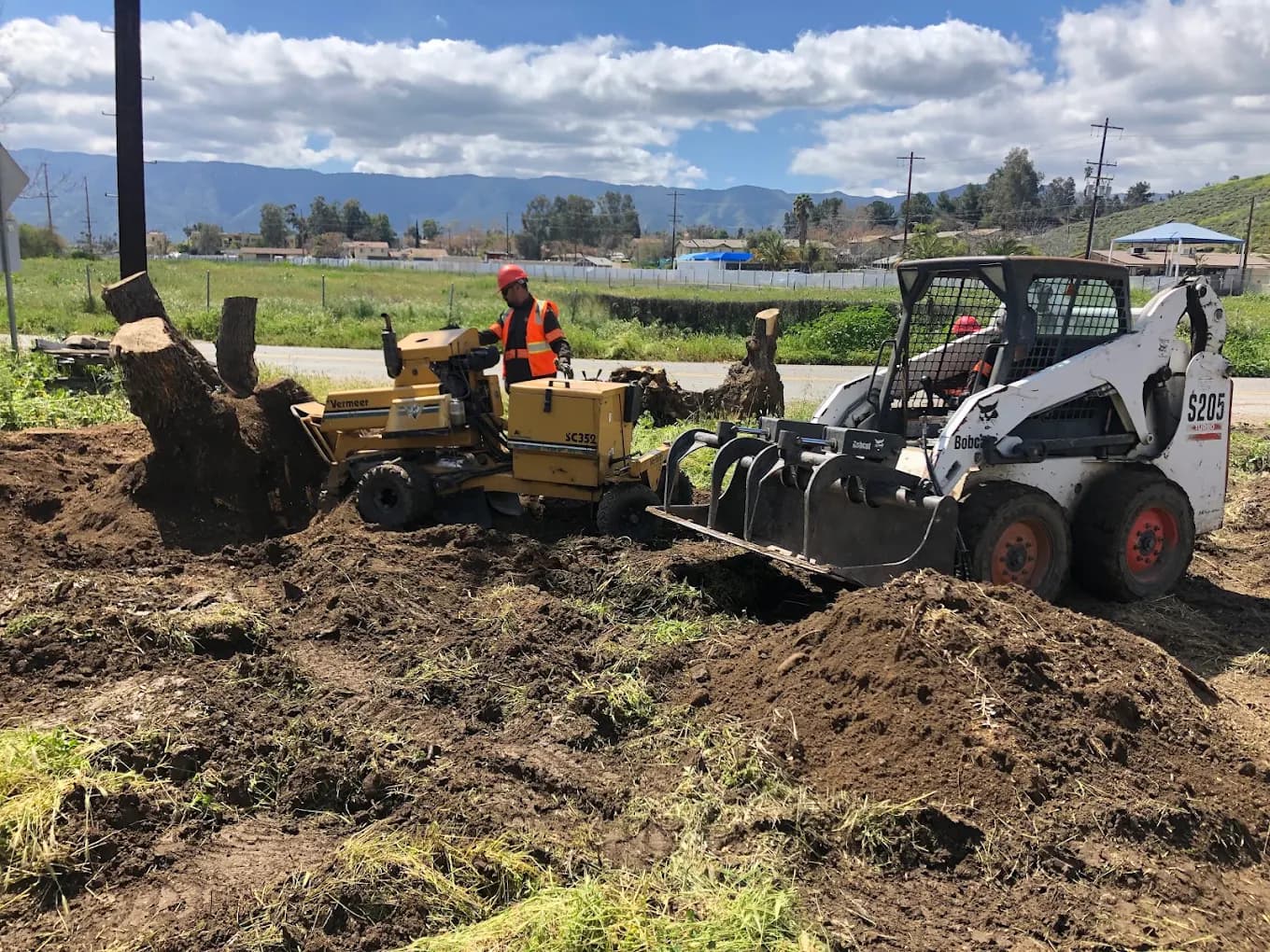
ISA Certified Arborist
An ISA Certified Arborist leads every trim. The arborist reads the canopy, sets the goal of the trim and picks which limbs come out.
Licensed, Bonded & Insured
CA license #1002853 covers C-27 Landscaping and C-61/D-49 Tree Service. We are bonded, carry general liability, and every employee has workers' comp for work up in the canopy.
Southern California Since 1985
We have pruned trees across Southern California since 1985. We time each trim to the species and the season, often the dormant months.
Our Own Equipment
Our own 75-ft boom trucks reach high canopies over roofs and streets. Our chippers take the brush, and all of it leaves on our trucks.
How a tree trimming job is planned and cut
- 01.
Species and objective first
An arborist drives out, identifies the species, reads the canopy and agrees what the trim is for — clearance from a roof, light into a yard, weight off an over-extended limb, or the tree's own structure.
- Free on-site visit
- Objective agreed before cutting
- 02.
Cut to ANSI A300
Reduction cuts go back to a lateral, collar cuts are made at the union, and no more comes off in one season than the tree can carry. Tools are cleaned between trees wherever disease is a risk.
- Collar cuts, never stubs
- No topping, no lion-tailing
- 03.
Read from the ground, then cleared
The crew comes down, the shape is checked from the ground and corrected, and the brush is chipped into the truck before the site is raked. All of it leaves on our trucks — one mature canopy is far past what a green waste cart holds.
- Canopy checked from the ground
- Full clean-up included
Where we work across Southern California
5 counties — Orange, Los Angeles, San Diego, Ventura and Santa Barbara — worked by crews running out of Santa Ana. These 7 areas are where most of it happens. Call 877-787-7363 if you are not sure whether your address falls inside them.
See every town we serveRecent tree trimming & pruning jobs
Real photos and videos from our own job sites. Tap any one to see it full size.
Real reviews, straight from our Google profile
Every word below was written by a customer on Google, not by us. Long reviews are shortened to fit the card — never reworded — and the full list is one click away.
“Great pricing & service. Highly competent with tricky jobs. We have used them for more than 10 years.”
Melanie Butler
Local Guide
“We got bids from five contractors. After I talked to them all and checked out their licenses and work, we decided to go with Supreme. … The job took a day and a half, and when they were done, they left the place immaculate.”
Hank Shaeffer
“Great tree trimmers! I’ve used Supreme Tree Experts twice to trim the palm trees in my yard. … The guys who come out are quick thorough, and clean. And very careful not to damage property.”
Emilie Pacheco
“These guys have worked on my property 3 times now. They are always on time and do a fantastic job. I highly recommend them!”
Ray Thompson
“After soliciting several quotes on some difficult yard work, we chose Supreme because of their licensed Arborist Temis … The crew was extremely hard working and we couldn’t believe their continuous work ethic on one of the hottest days of the year.”
Gary Brown
Local Guide
“Had them take out some tall eucalyptus trees on my lot in Hollywood. Great service. Fast, friendly and professional.”
Kirk Lee
Local Guide
Tree trimming questions from property owners
Timing by species, frequency, what is safe to do yourself, topping and what happens to the brush — the six the sections above do not already cover. If yours is not here, call 877-787-7363 and ask.
Late fall through early spring, while the tree is dormant, for anything structural. Dead, diseased and hazardous limbs come off in any month without harming the tree. Deciduous trees are best cut once the leaves are down; conifers and other evergreens do better in late winter, which also cuts the risk of bark beetle. The month to avoid is the spring flush, when the tree has just spent its stored energy putting new growth out. And the constraint that overrides the calendar is nesting: California Fish and Game Code 3503 makes it unlawful to take, possess or needlessly destroy the nest or eggs of any bird, and 3503.5 covers birds of prey with no needlessly about it. Most California nesting falls between 1 February and 31 August — a convention from the Western Chapter ISA's own guidance rather than a date in the code, because CDFW publishes no standard season. Either way, an active nest moves the date rather than the method.
Not more than a quarter of the live foliage in a growing season, and less than that on an old tree. That figure has a history worth knowing. ANSI A300 carried 25% as a recommendation — a should, never a shall — and the 2017 revision dropped the fixed number altogether in favor of a judgement made per tree. Some cities still use 25% as their own policy for public trees, so the number is alive even though the national standard has moved past it. What has not changed is the reason behind it: a tree pays for regrowth out of stored energy, and an older tree has less of it to spend.
Anything you can reach with both feet on the ground is fair; the ladder is the line. A pole pruner used on limbs you can stand under, well clear of any line, is ordinary yard work and worth doing. Above that the job changes shape — a ladder wants one hand on it and a running saw wants two, which is where most homeowner tree injuries come from. The cutting goes wrong in a predictable way as well: a limb taken in a single pass, overhead and at arm's length, tears bark down the trunk as it falls, and that strip of damage ends up larger than the cut that caused it. Nothing over a roof, nothing near a line, and nothing you would have to climb.
Topping is cutting a limb back to a stub with no lateral big enough to take over, and no — we will not do it. It is also called heading, tipping or rounding over. Everything that goes wrong afterward comes from that one cut: the tree cannot close a wound that size, so decay runs down the open stub; it answers with a mass of fast, weakly attached epicormic shoots; bark that spent decades shaded is suddenly exposed and scalds; and within a decade the tree is taller than it was, held together by attachments that were never structural.
In Santa Ana, our home city, the city does — that strip is public right of way, and the tree standing in it is a street tree. Under SAMC 33-189 the city maintains its urban forest on an average four-and-a-half-year trimming cycle and keeps a clear space of fourteen feet above the street or the sidewalk — one figure covering both, which is unusual. Report one that needs attention to the Public Works Agency on (714) 647-3380 or through the mySantaAna app. The code sets out no permit for a resident to prune one, but the tree belongs to the city and topping it is unlawful under SAMC 33-190, so the call is the better first move than a saw.
Yes, chipped on site and hauled away in our own trucks. Tree trimming generates far more small material than a tree removal does — well past what a green waste cart holds — so the chipper runs alongside the crew rather than at the end, and the pile never builds up across the yard.