
Landscaping in Santa Ana & Southern California
Based in Santa Ana, CA, we handle design, planting, irrigation, drainage and brush clearance across the five counties we cover — under the same California license as the tree work, so the trees and the ground around them are one contractor.
Landscaping
Why the tree work goes first
Tree work goes first. Tree removals, stump grinding and heavy tree trimming drag equipment and wood across finished ground; planting, irrigation and turf follow. Reversing that order is the most common way a new landscape gets paid for twice.
When a yard needs redesigning rather than maintaining
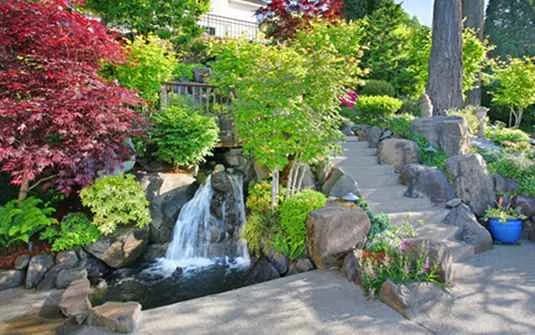
Most yards that get replanted did not fail — they finished. A planting scheme has a working life, and the point where maintaining it costs more than replacing it arrives quietly. These are the versions of it that owners actually call about.
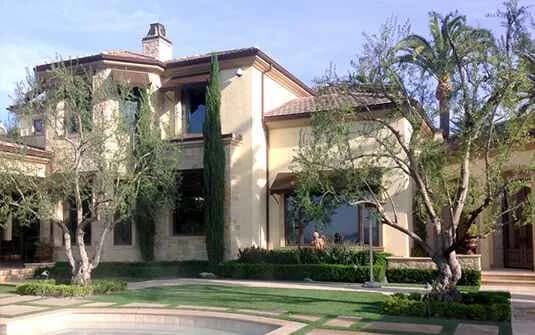
The planting has outgrown the beds — shrubs chosen at 3 feet are now 8, the beds have closed up, and cutting them back twice a year is holding a shape the plants stopped wanting
The water bill keeps climbing and the lawn is the reason — turf is the thirstiest thing on a typical property and usually the least-used part of it
Half the beds are bare and half are overgrown — that is almost always irrigation coverage rather than plant choice, and replanting without fixing it produces the same result again
Water runs toward the house instead of away from it — grading and drainage, and the only item on this list that actively gets worse rather than staying still
A tree came out and left a hole in the design — a tree removal or a stump grind changes the light on everything around it, and the planting underneath was chosen for shade that no longer exists
The property is going on the market — the front yard is the first thing a buyer sees, and among the cheapest things on a property to change
Not everything on this list is a redesign. A yard that was planted correctly and has simply got away from you is a maintenance problem, and saying so costs us the bigger job. Worth establishing which one you have before anything gets priced.
Landscape styles for Southern California, and what each costs in water
Five of the eleven below are native to this climate and six are imported into it. Southern California sits in a Mediterranean climate — hot dry summers, mild wet winters, and rain arriving in the months planting needs it least. A style chosen against that runs on the irrigation system for the rest of its life, which is a decision worth making deliberately rather than from a photograph.
Mediterranean
Water demand: Low waterOlive, rosemary, lavender, citrus and gravel, with planting that expects a dry summer and treats it as normal. The climate here is Mediterranean, so this is the style asking least of the irrigation system.
Tuscan
Water demand: Low waterA regional dialect of the same idea — Italian cypress, olive, stone and terracotta, with muted greens in place of flower color. Reads formal without needing to be clipped to stay that way.
Xeriscape
Water demand: Low waterDesigned around the water available rather than around a picture. It is not the same as an empty yard: a xeriscape can be densely planted, it simply plants things that do not need a weekly soak.
Desert
Water demand: Low waterAgave, aloe, yucca and palo verde over decomposed granite. The lowest-maintenance planting on this list and the least forgiving of bad drainage — most of it dies from too much water rather than too little.
Southwest
Water demand: Low waterSucculent and cactus planting set against adobe, warm stone and weathered steel. The same water demand as desert with considerably more built material in the picture.
Modern
Water demand: Moderate waterGeometry rather than species: clean edges, one thing planted in quantity, and space left deliberately empty. Water demand follows whatever gets massed, so this style can sit anywhere on the scale.
French
Water demand: Moderate waterFormal symmetry, gravel walks, clipped hedging and standards. It holds its shape only while it is being cut, so the recurring cost here is labor rather than water.
Colonial
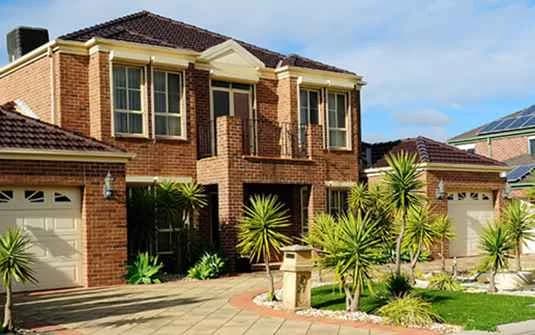
Water demand: Moderate waterSymmetry across the front elevation, clipped boxwood, brick and a centered walk. A shearing schedule more than a planting scheme, and it looks wrong the moment it is a month late.
Country
Water demand: Moderate waterInformal mixed borders, layered heights and deliberate untidiness. Forgiving of imperfect maintenance in a way none of the formal styles are, which is worth more than it sounds.
English
Water demand: High waterDeep perennial borders, lawn, roses and dense layered planting. Built for a cool wet climate, so here it needs shade, real irrigation and honest expectations about August.
Tropical
Water demand: High waterBroad-leaved planting, palms and heavy foliage. The highest demand on this list, and it works best planted under an existing canopy that shelters it from afternoon sun rather than out in the open.
Drought-tolerant does not mean no-maintenance, and it does not mean a smaller planting budget. One rule worth knowing before choosing: California's Model Water Efficient Landscape Ordinance sets limits on turf area, irrigation controls and mulch depth once a new or rehabilitated landscape passes a size threshold, and cities adopt their own version of it. Which side of that line a project falls on changes the plant list rather than just the paperwork — so it is a design-stage question, not an inspection-day one.
How much does landscaping cost?
It is priced on area and on what is under the ground, not on the style chosen. Two yards the same size with the same plant list can differ by a factor of three, and the difference is almost always demolition, irrigation and drainage — the three parts nobody photographs.
The 6 things a landscape installation is priced on
Area, and how much of it changes
Square footage of the work rather than of the lot. A front yard replanted around an existing layout and a whole property taken back to bare soil are different projects at the same address.
What has to come out first
Old concrete, dead turf, failed irrigation, stumps and root plates. Demolition and haulage routinely cost more than the planting that replaces them, and it is the line most estimates leave vague.
Irrigation — new, extended or repaired
Extending a working system onto new beds is straightforward. A new system, or a 20-year-old one that has been patched every season since, means trenching the whole area and is priced as its own job.
Grading and drainage
The invisible half. Where water sits now, where it should go, and whether the ground has to be re-shaped to send it there. Skipping this is the commonest reason a new landscape fails in its second winter.
Plant size at installation
The same tree is a 15-gallon, a 24-inch box or a 36-inch box, and the gap between them is large. Bigger is not automatically better — smaller stock establishes faster and often overtakes a boxed specimen within a few years.
Built work in the same scope
Paving, walls, walkways and edging price separately from the planting. Whether they are in or out changes the shape of a quote far more than any plant choice does.
The $600 minimum is on tree services and does not apply to landscaping — this side is quoted on the work itself. The estimate costs nothing either way.
Planting, irrigation, drainage and clearance
The license the tree work runs on is the license this runs on — C-27 Landscaping alongside C-61/D-49 Tree Service on CSLB #1002853. These are the operations on the C-27 side, and each one can be scheduled around the tree work rather than after somebody else has finished with the site.
Book a free site visitDesign and layout
Where things go, and why, before anything is bought. Mature size rather than nursery size sets the spacing — that single decision is the difference between a scheme that fills in and one that has to be thinned out in five years.
Planting
Trees, shrubs, ground cover and perennials, set at the depth the root flare wants rather than the depth the container suggests. Most first-year losses are a plant buried too deep or a hole that never drained.
Irrigation
New systems, extensions onto new beds, and repairs to what is already in the ground. Drip on beds and spray on turf are separate zones for a reason — run off one valve, one of them is watered wrong permanently.
Grading and drainage
Shaping the ground so water leaves the building and the root zones instead of collecting in them. Done before planting, because it is excavation — retrofitting it means lifting the planting back out.
Turf and turf alternatives
Lawn where a lawn is actually walked on, and something else where it is only being looked at. Most of the water saved on a residential property is saved here rather than anywhere else in the yard.
Brush clearance
Overgrowth, dead fuel and volunteer growth cleared off a property, on hillsides and around structures. A separate operation from landscaping, and often the first one a neglected site needs.
Why Supreme Tree Experts for landscaping around your trees
Tree work goes first, then the planting. Removals, stump grinding and heavy trimming drag equipment across finished ground. Doing it the other way round is how a new yard gets paid for twice. One visit prices the trees, planting, irrigation and built work together.
Grading, drainage and irrigation go in while machines can still cross the site. Buried lines are located first. Planting goes in last, set at the depth the root flare wants. Every irrigation zone is run and adjusted, and the site is left clean.
ISA Certified Arborist
An ISA Certified Arborist looks after the trees near the work. The arborist protects root zones and decides which roots, if any, can be cut.
Licensed, Bonded & Insured
CA license #1002853 covers C-27 Landscaping and C-61/D-49 Tree Service. We are bonded, carry general liability, and every employee has workers' comp for trenching and digging.
Southern California Since 1985
We have worked on yards across Southern California since 1985. We plan for hot, dry summers and mild, wet winters.
Our Own Equipment
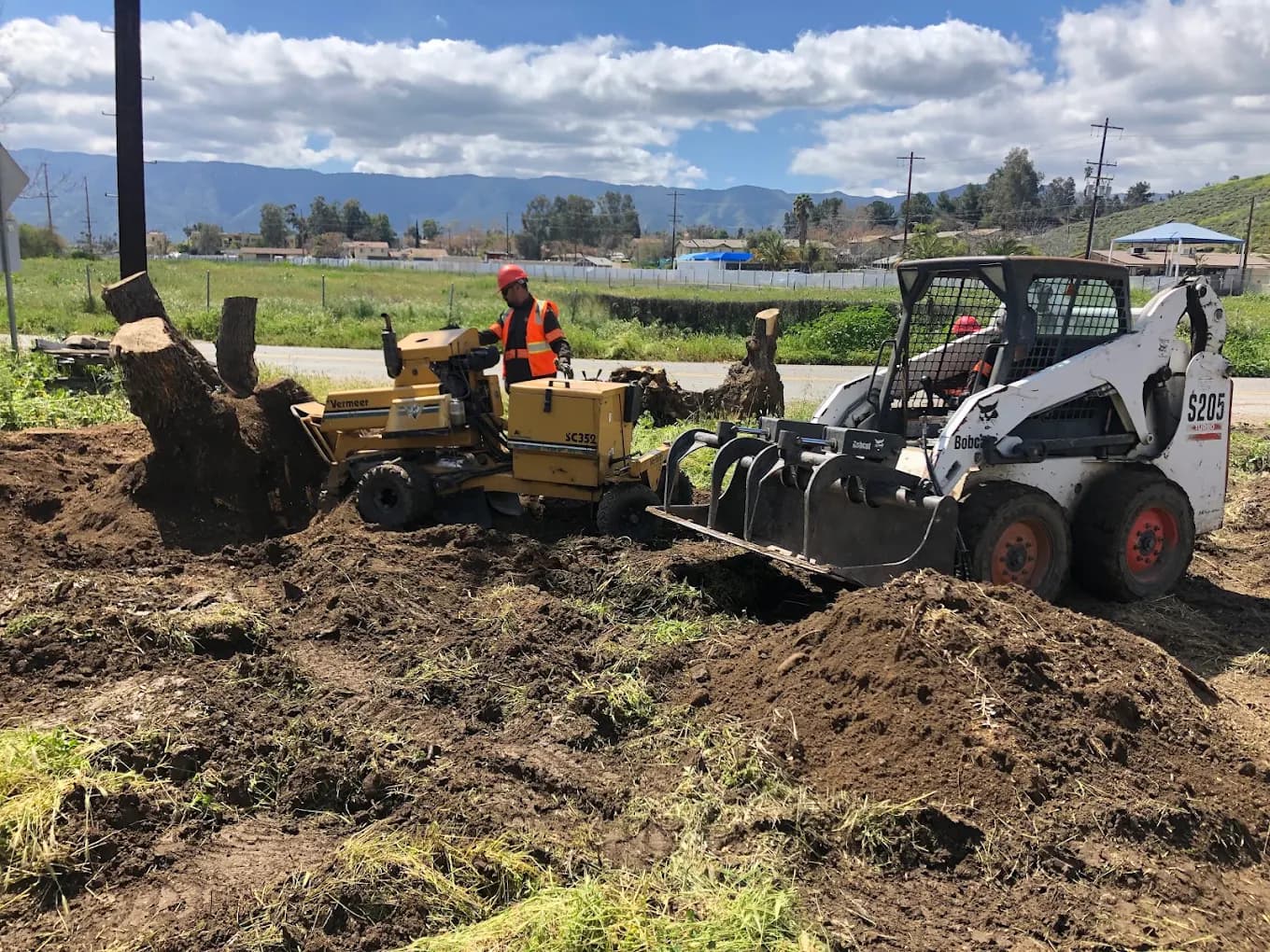
Our own bobcats handle grading and demolition. Our haulers clear old turf, concrete and debris, so the site is ready for planting.
How a landscape job is sequenced
- 01.
One visit for the whole property
Someone drives out and prices the trees, the planting, the irrigation and any built work in a single pass, so no part of it is quoted against a guess about what another trade is doing.
- Free on-site visit
- Every trade quoted from one visit
- 02.
Ground before planting
Demolition, grading, drainage and irrigation go in while machines can still cross the site and while anything buried can still be found. Planting is last, because everything else drives over it.
- Buried lines located first
- Drainage set before planting
- 03.
Planted, irrigated, handed over
Planting goes in, every irrigation zone is run and adjusted, and the site is cleaned down. The controller is set for establishment rather than for a mature landscape — two different programs.
- Every zone run and adjusted
- Site left clean
How to judge a landscape contractor
The gap between a good landscape contractor and a cheap one shows up about two years later, which is exactly when it is expensive to find out. Six things worth asking whoever you hire — as useful for checking us as for checking anybody else.
Check the license class, not the word "licensed"
California issues by classification. Landscaping is C-27; tree work is C-49 Tree & Palm for licenses issued from 2024 and C-61/D-49 Tree Service on older ones, and a contractor can hold one without the other. The number, the classification, the status and the bond are all public — look them up on the CSLB's own site rather than reading them off a truck door.
Ask who does the work, and who does it afterward
Some firms design and hand over a drawing. Some install and never come back. Some only maintain. Knowing which of the three you are buying — and whether it is one company or three — settles in advance whose fault the dead planting is.
Ask what happens to the irrigation
A new planting scheme on an old irrigation layout is the commonest way a landscape dies in its first summer. Whether the system is being extended, rebuilt or simply reused belongs in the quote as a line, not left as an assumption.
Get the warranty in writing, with a period on it
Plants, materials and workmanship are three separate things, and a warranty can cover one and not the others. Ask what voids it too — on most plant warranties the answer is the irrigation, which is why the question above matters.
Ask to see the plan before anything goes in the ground
A drawing, a plant list, or even a hose laid out on the soil. Changing a design on paper costs nothing and changing it after planting costs the job twice. A contractor who cannot show you what they intend has not decided yet.
Get a written contract with a completion date on it
Scope, price, payment schedule and a date. The date matters more here than it sounds: a half-finished yard is a mud pit, and planting has a season that does not wait for a schedule to catch up.
Where we work across Southern California
5 counties — Orange, Los Angeles, San Diego, Ventura and Santa Barbara — worked by crews running out of Santa Ana. These 7 areas are where most of it happens. Call 877-787-7363 if you are not sure whether your address falls inside them.
See every town we serveRecent landscaping jobs
Real photos and videos from our own job sites. Tap any one to see it full size.
Real reviews, straight from our Google profile
Every word below was written by a customer on Google, not by us. Long reviews are shortened to fit the card — never reworded — and the full list is one click away.
“Great pricing & service. Highly competent with tricky jobs. We have used them for more than 10 years.”
Melanie Butler
Local Guide
“We got bids from five contractors. After I talked to them all and checked out their licenses and work, we decided to go with Supreme. … The job took a day and a half, and when they were done, they left the place immaculate.”
Hank Shaeffer
“Great tree trimmers! I’ve used Supreme Tree Experts twice to trim the palm trees in my yard. … The guys who come out are quick thorough, and clean. And very careful not to damage property.”
Emilie Pacheco
“These guys have worked on my property 3 times now. They are always on time and do a fantastic job. I highly recommend them!”
Ray Thompson
“After soliciting several quotes on some difficult yard work, we chose Supreme because of their licensed Arborist Temis … The crew was extremely hard working and we couldn’t believe their continuous work ethic on one of the hottest days of the year.”
Gary Brown
Local Guide
“Had them take out some tall eucalyptus trees on my lot in Hollywood. Great service. Fast, friendly and professional.”
Kirk Lee
Local Guide
Landscaping questions
Lawn care against landscaping, planting under established trees, when to plant, and what happens to the lawn — six the sections above do not already answer. If yours is not here, call 877-787-7363 and ask.
Landscaping installs; lawn care maintains. Landscaping is the design and installation of both halves of a yard — the softscape, meaning plants, trees, turf and ground cover, and the hardscape, meaning paving, walls, walkways and edging. Lawn care is the recurring work that keeps the result alive afterward: mowing, edging, feeding and checking the irrigation. They are separate contracts, frequently from separate companies, and the join between them is where warranty arguments happen. Worth settling which one you are actually buying before the first visit.
Yes, but the tree sets the rules and the design works around them. Three constraints decide it. Soil must not be piled over the root flare or against the trunk, so a raised bed built around an existing trunk is a slow way to kill it. Irrigation must not be trenched through the root zone, because the roots cut to run that line are the ones holding the tree up. And the planting has to tolerate shade and drought together, since a mature tree takes most of the water in its own root zone before anything underneath it sees any. Get this wrong and you lose the tree — the one thing in a yard that money cannot put back on any useful timescale.
Fall, and it is not close. Planting in October or November hands roots the whole cool wet season to establish in before they are asked to survive a summer, which is the test that kills new planting. Spring works with attentive irrigation. Summer planting is possible and done routinely, but it means hand-watering through establishment and a higher failure rate on anything that misses a week. Where a schedule has any flexibility in it at all, moving an installation to fall is the cheapest single thing that improves its odds.
No — but the lawn is where nearly all of the saving is. Turf is the thirstiest planting on a typical residential property, so reducing its area moves the water bill more than any other change in the yard. Reducing is not removing: keeping lawn where it is walked on and replacing it where it is only looked at usually cuts the irrigated area substantially while leaving the part of it you actually use. Where turf comes out entirely, what replaces it matters — a planted low-water scheme holds up in this climate, while bare gravel gets hot enough to cook whatever is planted beside it.
It changes what a buyer decides before they get out of the car, which is not the same thing as a line on an appraisal. Front-yard planting is the first thing anyone sees and among the cheapest things on a property to change, so it moves the impression a house makes out of all proportion to what it costs. What it does not do is appear as an itemized figure the way a kitchen does — appraisers treat site improvements as part of overall condition and appeal rather than as a separate number. One caution worth hearing: a design that visibly needs constant work can read as a liability instead of an asset, because buyers price maintenance too.
Yes, and it can run on the same schedule as the tree work. New planting is at its most vulnerable through its first two summers, which is exactly when it tends to be left alone because it already looks finished. Maintenance visits cover the irrigation as much as the planting — a controller still running last year's program is the commonest reason a scheme thins out for no visible cause.