
Tree Maintenance Programs in Santa Ana & Southern California
Scheduled tree care on a set cycle from our base in Santa Ana, CA across the five counties we cover — trimming, deadwood, health checks and storm prep, priced per visit instead of per emergency.
Tree Maintenance Plans
Why a cycle costs less
A tree on a three-year rotation is trimmed while the cuts are still small. Deadwood comes off before it falls, over-extended limbs are reduced before they tear out, and the crew already knows the property — so each visit is shorter than the one-off job that would otherwise replace it. Reactive tree trimming is priced against urgency; cyclical tree trimming is priced against a calendar.
Why trees go on a schedule instead of a call list
Santa Ana winds arrive every year from September through May — that is the National Weather Service window, and it is wider than most people expect. Everything below is easier to deal with before that than after it.
Neglect is a liability, not just a mess — anywhere in California, a failure from a defect that was visible and left untreated is the version an insurer and a court both look at differently
Deadwood comes down on its own schedule — a dead limb in a canopy is already detached in every way except the last one
Low limbs over a driveway or sidewalk — the everyday damage nobody photographs: roof racks, delivery vans, and the neighbor's car
Dry, dead material is fuel — standing deadwood and fallen litter against a structure is the cheapest fire load on a property to remove
An unkempt frontage is visible from the street — and to anyone valuing the property, which is the one time it turns into a number
A heavy canopy starves what is under it — grass and planting thin out under a crown nobody has let light through in three years
None of this is urgent in the week you read it. All of it is cheaper on a cycle than as a call-out, and on any property the cycle is what turns tree care into a line in a budget rather than a surprise in one.
The 8 things an inspection is looking for
An inspection is a list, not an impression. These eight are the items one city has its own inspectors check on the street trees it maintains, and they are the same eight worth checking on yours — because seven of them are visible from the ground and the eighth is why the other seven get missed.
Deadwood in the canopy
What it changes: Dealt with on the visitDead branches are already detached in every way but the last one. This is the shortest item on any visit and the one that removes most of what actually falls on people and property.
Hangers and broken branches
What it changes: Dealt with on the visitA limb torn out but caught in the canopy comes down at a time nobody chooses. On a cycle it is found at the visit; off a cycle it is found by whatever is underneath it.
Weakly attached scaffold limbs
What it changes: Dealt with on the visitA major limb joined at a narrow angle, often with bark squeezed into the union rather than wood. Caught early it is a reduction cut; caught late it is a cable, or the limb on the driveway.
Co-dominant or multiple trunks
What it changes: Changes the planTwo leaders competing where one should be. The single commonest failure point in a mature tree, and the reason structural pruning on a young tree is the cheapest work anybody buys.
Cracks in trunks and branches
What it changes: Changes the planA crack is the tree telling you the load has already exceeded what the wood will carry. It moves a tree up the cycle rather than waiting its turn, and sometimes off the cycle entirely.
Lean and root problems
What it changes: Changes the planA lean the tree has always had is usually structural. A lean that appeared since the last visit is a root plate that has moved, and that is the one finding that does not wait for the next scheduled date.
Cavities, cankers and mushrooms
What it changes: Changes the planFruiting bodies at the base or on the trunk mean decay is already established inside, and a conk is the visible end of something that has been going on for years. What it changes is how the tree gets worked, before it changes whether it stays.
Pests and diseases
What it changes: Changes the planFound by looking on a schedule rather than by spraying on one. UC IPM's own guidance is to monitor on a schedule and treat only on what monitoring finds — calendar-based pesticide treatment is the thing it tells property managers not to buy.
Seven of the eight are visible from the ground by somebody who knows what they are looking at, which is what the ANSI A300 tree care standards call a Level 2 assessment: a full 360-degree walk around the tree, taking in crown, trunk, trunk flare, surface roots and what the tree is standing over. A Level 1 is a limited visual pass across a whole population. A Level 3 is the one with instruments in it — resistance drilling, sonic tomography, a pull test — and it happens only where a Level 2 cannot settle the question.
Does anything in California require you to inspect your trees?
Nothing in California law sets an inspection interval for a private property, and nothing requires that a certified arborist be the one who looks. What there is instead is a duty of ordinary care, and a question a court asks afterwards: did the owner know, or should the owner reasonably have known. That is the whole of it, and it is worth more to you stated plainly than dressed up.
| The obligation | Where it comes from | Sets an interval? |
|---|---|---|
| Ordinary care in managing your property | California Civil Code 1714 — the general duty, trees included | Does not |
| Reasonable inspection of trees beside a road | Coates v. Chinn (1958) 51 Cal.2d 304, which in the same breath says there is no liability for a defect inspection would not reveal | Does not |
| Maintaining the common area | Civil Code 4775 — on the association, unless the declaration says otherwise | Does not |
| Visual inspection of major components | Civil Code 5550 — at least every three years for a reserve study, reviewed annually | Sets one |
| Inspecting the city's own street trees | The Urban Forest Management Plan of Santa Ana, our home city — no greater than five years | Sets one |
| Hiring a certified arborist to inspect | No California statute or case requires one | Does not |
Two honest limits on all of this. Whether trees belong in an association's reserve study is a judgement its reserve analyst makes — 5550 does not name them, and plenty of associations fund tree work from operating instead. And the ANSI A300 tree care standards ask that any recommendation short of removal carry an advisory that not all the structural and stability concerns that come with a tree can be eliminated — a should rather than a shall, and still the reason nothing on this page says a plan makes a tree safe, only that it changes what is known about it and when. This is general information about the framework, not legal advice; the specifics of your property are a conversation with your own attorney or insurer.
How much does a tree maintenance plan cost?
Per visit against a schedule agreed up front, starting at the $600 tree-services minimum — not a monthly retainer, and not a figure per tree. A plan is the same work as a one-off job, priced with the travel, the set-up and the surprise taken out of it.
The 6 things a maintenance plan is priced on
How many trees, and what they are
A property with 4 mature oaks and one with 40 mixed ornamentals are different plans. Species drives it as much as the count — palms want an annual visit, a coast live oak wants something quite different.
How often each tree needs a visit
Trees are grouped rather than treated as one schedule. A three-year rotation on the slow growers and an annual visit on the palms means most trees are not being paid for every year.
What each visit actually includes
Crown cleaning is a short visit. Structural pruning and reduction on a mature tree is not. The plan says which trees get which, so the price is set before the crew arrives rather than discovered.
Access across the property
Whether a truck and chipper reach the work, or the material has to be carried out by hand. On block-walled lots and on any bigger property, this changes the day more than the cutting does.
How long since anything was done
The first visit on a neglected property is always the largest, because it is catching up on several years at once. From the second cycle onward the visits get shorter and the price follows.
Whether it is a shared or managed property
HOAs and managed portfolios need the scope written line by line for a board to approve and the visits scheduled around residents. That is process rather than extra work, and it is built into how the plan is quoted.
The minimum applies to any single visit. On a property with more than a handful of trees it stops being the number that decides anything, and the schedule takes over.
What is actually in a tree maintenance plan
On a Southern California property most owners need four or five of these six, and almost nobody needs all six every year. Which is the point of writing the plan down: a tree that wants a visit every third year stops being paid for annually, and a palm that wants one every year stops being forgotten.
Book a free site walkCyclical tree pruning
The core of any plan. Structure corrected and the canopy thinned on a set rotation, while the cuts are small enough for the tree to close over — which is the whole economic argument for doing this on a cycle at all.
Deadwooding and crown cleaning
Dead, dying, diseased and broken wood out of the canopy. The shortest visit on the list and the one that removes most of what actually falls on people and property.
Clearance work
Limbs kept off roofs, gutters, driveways, walkways and signage as they grow back into them. On a cycle it is a trim; left alone for a few summers it becomes a reduction.
Root management
Where roots are lifting paving, entering drains or competing with planting. Which roots can be cut, and how far out, is an arborist's decision — cutting the wrong one destabilizes the tree above it.
Storm preparation
Scheduled ahead of the wind season rather than after it, which here means the work lands between late spring and early autumn. A canopy already thinned catches less wind, and the over-extended limbs that tear out first are gone before the wind reaches them.
A record that carries forward
Every tree on the property noted once — species, size, condition, what it stands over — and updated each visit. A tree declining faster than expected moves up the cycle instead of waiting its turn.
Why Supreme Tree Experts for a tree maintenance program
A tree on a cycle is trimmed while the cuts are still small. Deadwood comes off before it falls, and long limbs are reduced before they tear out. Each visit is shorter than the one-off job it replaces. It is priced per visit, not as a monthly retainer.
An arborist walks the grounds and records every tree: species, size, condition and what it stands over. Trees are grouped by how often they need a visit. Work is booked before the wind season. A tree that declines faster than expected moves up the cycle.
ISA Certified Arborist
An ISA Certified Arborist builds each plan. The arborist records every tree, sets its cycle and decides which roots can be cut safely.
Licensed, Bonded & Insured
CA license #1002853 covers C-27 Landscaping and C-61/D-49 Tree Service. We are bonded, carry general liability, and every employee has workers' comp on every scheduled visit.
Southern California Since 1985
We have cared for trees across Southern California since 1985. We schedule storm prep between late spring and early autumn, ahead of the winds.
Our Own Equipment
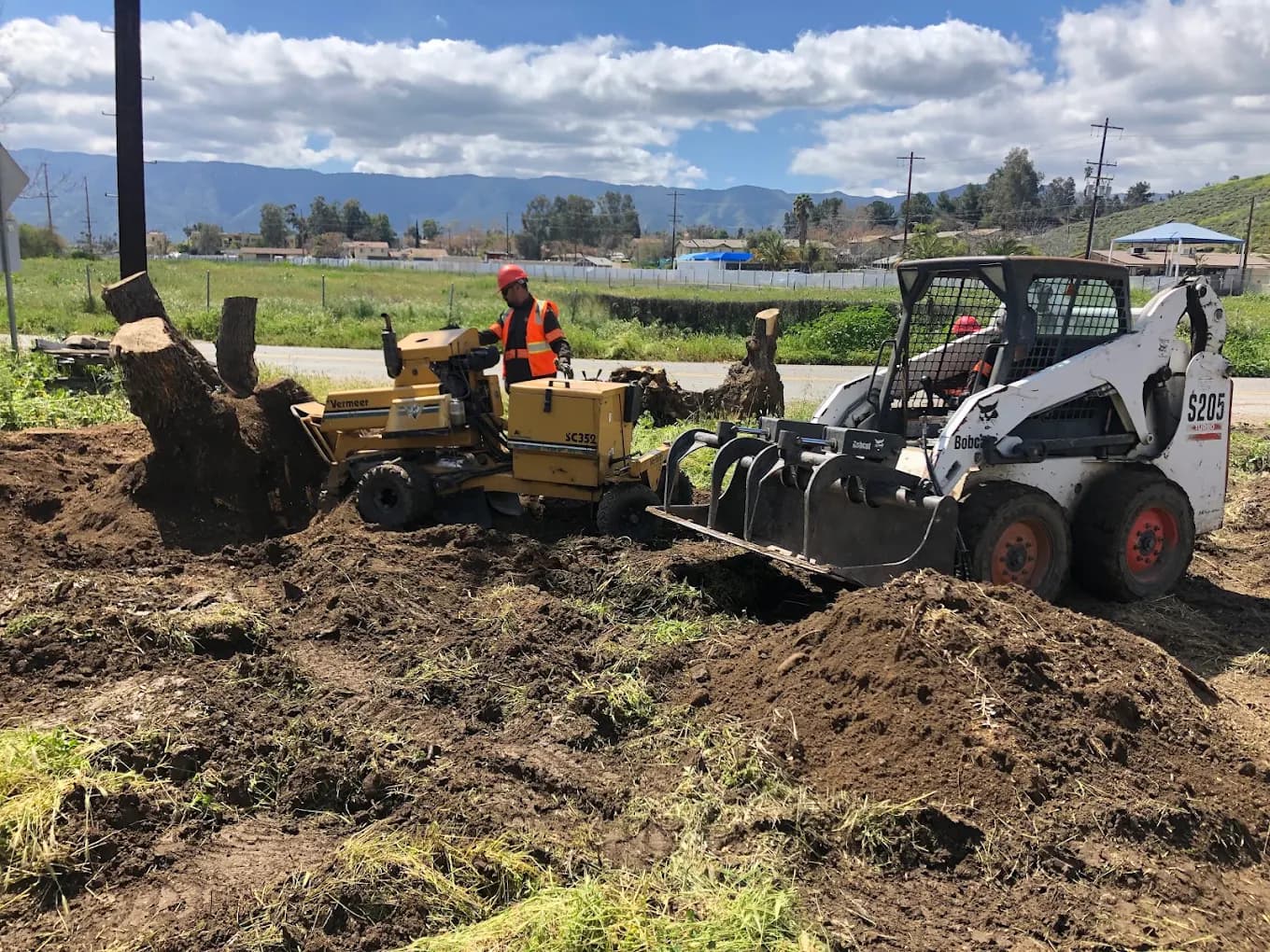
Our own 75-ft boom trucks reach upper crowns for deadwood work. Our chippers and haulers clear what comes down on each visit.
How a tree maintenance plan is built
- 01.
Every tree on the property, recorded
An arborist walks the grounds anywhere in our service area and records the trees — species, size, condition, and what each one is standing over.
- Free on-site walk
- Every tree, not just the problem one
- 02.
Grouped into a cycle
Trees are grouped by how often they need a visit, and the visits are scheduled ahead of the Santa Ana wind season rather than after it.
- Priced per visit
- Scheduled before Santa Ana season
- 03.
Worked, then reviewed
Each visit is carried out to the plan, and what changed is noted — a tree declining faster than expected moves up the cycle instead of waiting its turn.
- Plan adjusts as trees change
- Same crew, same property
Where we work across Southern California
5 counties — Orange, Los Angeles, San Diego, Ventura and Santa Barbara — worked by crews running out of Santa Ana. These 7 areas are where most of it happens. Call 877-787-7363 if you are not sure whether your address falls inside them.
See every town we serveRecent tree maintenance jobs
Real photos and videos from our own job sites. Tap any one to see it full size.
Real reviews, straight from our Google profile
Every word below was written by a customer on Google, not by us. Long reviews are shortened to fit the card — never reworded — and the full list is one click away.
“Great pricing & service. Highly competent with tricky jobs. We have used them for more than 10 years.”
Melanie Butler
Local Guide
“We got bids from five contractors. After I talked to them all and checked out their licenses and work, we decided to go with Supreme. … The job took a day and a half, and when they were done, they left the place immaculate.”
Hank Shaeffer
“Great tree trimmers! I’ve used Supreme Tree Experts twice to trim the palm trees in my yard. … The guys who come out are quick thorough, and clean. And very careful not to damage property.”
Emilie Pacheco
“These guys have worked on my property 3 times now. They are always on time and do a fantastic job. I highly recommend them!”
Ray Thompson
“After soliciting several quotes on some difficult yard work, we chose Supreme because of their licensed Arborist Temis … The crew was extremely hard working and we couldn’t believe their continuous work ethic on one of the hottest days of the year.”
Gary Brown
Local Guide
“Had them take out some tall eucalyptus trees on my lot in Hollywood. Great service. Fast, friendly and professional.”
Kirk Lee
Local Guide
Tree maintenance questions from property owners
Doing it yourself, how emergencies sit alongside a plan, who inspects, and what you are actually committing to — six the sections above do not already answer. If yours is not here, call 877-787-7363 and ask.
The small stuff, yes — and a plan does not stop you. Watering, mulching, keeping suckers down and cutting a low branch you can reach are all perfectly reasonable to do yourself. Where it goes wrong is the cutting: the wrong cut in the wrong place at the wrong time of year does not grow out. A flush cut removes the collar the tree closes wounds with, a stub never closes at all, and a heavy cut during the spring flush hits the tree when its stored energy is already spent. None of those show up for a year or two, which is why people repeat them.
They are separate, and a plan makes the second one rarer. Scheduled visits are priced per visit against the agreed cycle. Storm work is 24/7 emergency response and it is quoted on what is in front of us at the time. What a plan changes is how often that call happens — the deadwood and over-extended limbs that fail first are already off.
By what the last assessment found, not by the calendar. The ISA method rates a tree over a defined time frame — typically somewhere between one and five years — and the rating it comes out with is what sets the date for the next look. A tree rated low risk over five years does not need an annual visit; one rated high does not wait five. On most Southern California properties that produces two schedules rather than one, because palms and broadleaf trees rarely land on the same interval. For comparison, Santa Ana, our home city, caps its own street tree inspections at five years.
An ISA Certified Arborist — and no law obliges you to use one, which is rather the point of choosing to. The risk method itself has its own credential on top: the ISA Tree Risk Assessment Qualification, which has to be re-earned by retraining and retesting rather than renewed on paper. The assessment is as much the point of a maintenance visit as the cutting is, so it wants somebody qualified to say what a tree is doing — and to be wrong about it in writing if they are.
Yes — tree care for HOAs, apartment complexes, business parks and estates across Southern California. Commercial tree service covers the contract side, including scheduling around residents and access.
No — the schedule is an agreement about timing, not a lock-in. Each visit is quoted and approved on its own, so a plan is really a standing appointment plus a record of what the trees are doing. Skip a cycle and the only thing that happens is that the next visit is a larger one, because the work does not stop accumulating while the schedule is paused.