Tree Removal in Santa Ana & Southern California
Dead, leaning, hazardous and storm-damaged trees taken out across the five Southern California counties we cover from our base in Santa Ana, CA, by crews working under an ISA Certified Arborist. The on-site estimate costs nothing.
Tree Removal
When a tree has to come out
When the likelihood of failure stops being acceptable for whatever stands underneath it. That is the whole test, and it has two halves rather than one: the condition of the tree, and the target below it. A hollow trunk over an empty corner of a lot is not urgent. The same trunk over a driveway is, and nothing about the tree changed between those two sentences.
No tree job is too big for us to handle.
12 reasons a tree comes out
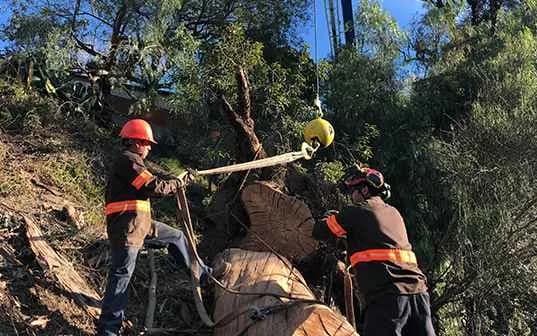
The first four decide themselves — at that point the tree has already made the choice. The rest are genuinely choices, and on the last two an arborist usually says a tree removal is not the answer.
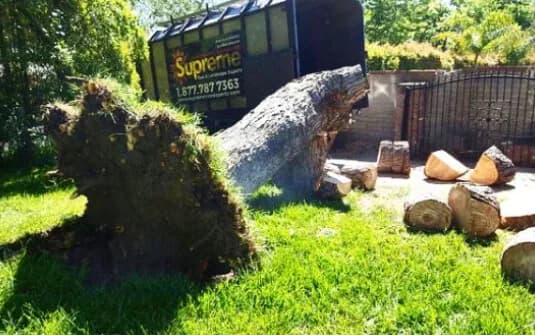
It has already failed — the tree is down, or a major limb has torn out of it
It is dead, or most of it is — no leaf in the canopy, bark shedding in plates, brittle wood
It has started leaning, and it was not leaning last year
There is decay at the base — fungal brackets, a cavity, or a trunk that sounds hollow
Roots are lifting hardscape — a driveway, a path, a block wall or a slab, which is what puts most mature ficus on a removal quote here
Roots have found a drain or a sewer line
It is too close to the house, or to the neighbor's
It is infested — the polyphagous shot hole borer and the Fusarium dieback it carries, longhorn borers, or rodents nesting in the crown
It is a fire risk where it stands — a resinous species hard against a structure
It blocks access or a sight line — a driveway, a walkway, a junction
The landscape is being rebuilt and the tree sits inside the footprint
You want the light back, or a different tree there — the two that are not about safety, and the two where reduction is often the better answer
One we cannot help with: we do not remove city trees. The city owns those and the city removes them. Which tree is whose is set out further down this page, and it is not always the one people expect.
The trees that come out most often
The species sets the method before the height does. Weight, wood strength and where the roots run decide what a crew does on the day, which is why two 60-foot trees on one street can be a one-day job and a three-day one. These nine come up most on removal quotes here, with what each one does that the others do not.
Mexican fan palm
What decides the job: HeightWashingtonia robusta runs to 80 feet and beyond on a trunk 10 to 14 inches through — about the width of a dinner plate, flaring wider at the base. Light next to a date palm, not light in absolute terms, so the job is overhead clearance and access first and weight second.
Canary Island date palm
What decides the job: WeightPhoenix canariensis is the heaviest single lift on most residential lots — a mature trunk is water-saturated fibre measured in tons. It comes down in lowered sections rather than felled. Fusarium wilt spreads on pruning tools, chainsaws above all, so blades are cleaned between palms; and because the fungus persists in the soil for decades, replanting a Phoenix on the same spot is not advised.
Indian laurel fig
What decides the job: RootsShallow roots that run 20 to 30 feet out and lift slabs whole are what put a ficus on a quote. Sold as ficus nitida or Chinese banyan, and naturalised across Orange County — the tree comes down in a day, the hardscape it moved is the longer half of the job, and the grinding has to go wider than the stump.
Eucalyptus
What decides the job: WeightRed gum inland, blue gum nearer the coast, and both are the genus known for summer branch drop — a heavy lateral leaving the tree in dry weather, late in the day or early morning, with nothing to trigger it. UC Cooperative Extension's California Tree Failure Report Program logs branch failures as 42% of recorded blue gum failures. Nothing comes off one freely near a structure.
Aleppo pine
What decides the job: WoodPinus halepensis is among the most widely planted ornamental pines in the Southwest, and the ones in the ground here are well past the height they were chosen for. Resinous, weak wherever a co-dominant union has included bark, and the host the Mediterranean pine engraver goes for once a drought-stressed tree stops pushing pitch.
Liquidambar
What decides the job: RootsA standard Southern California tract street tree and one of the first to reach a sidewalk. Straightforward to take down — the decision is almost always about the slab it lifted rather than the tree. It suckers from the roots for a year or more after the stump is out, so expect to cut them back rather than to be done in one visit.
Jacaranda
What decides the job: RootsJacaranda mimosifolia is on our home city's own street tree list at SAMC 33-185 and planted there in quantity, so it is often the tree in front of the house. Surface roots lift slabs, the wood is brittle at a narrow union, and the flower and pod litter is what starts most of the calls.
California sycamore
What decides the job: Pest-ledPlatanus racemosa sits on that same street tree list at SAMC 33-185 and is a reproductive host for the invasive shothole borer, which is established across Orange County and carries Fusarium dieback into the tree with it. Infested wood is chipped to an inch or smaller rather than stacked — that is what kills the beetles in it.
Coast live oak
What decides the job: Usually staysQuercus agrifolia is the one on this list an arborist argues to keep. Native, long-lived past 150 years, faster growing than its reputation, and on the same street tree list at SAMC 33-185 for five-to-eight-foot parkways — worth far more standing than the work of taking it out.
Species is one input. A quote is written off the tree in front of the arborist, never off a table — a 40-year-old ficus in an open back yard and the same tree six feet from a block wall are two different jobs for reasons the species does not explain.
Who owns the tree, and do you need a permit?
In our home city of Santa Ana, CA, no permit is needed to take out a tree on your own property. Rules differ from city to city, so check with yours before work begins. Chapter 33, Article VII of the city's Municipal Code (SAMC) — the article that governs trees — regulates public trees, the ones standing in the right of way, and creates no heritage, landmark or protected-tree designation. A historic district, a condition of approval on a newer development or an association's own rules can still apply, so check those before the saw. What the code does say about private trees runs the other way: SAMC 41-240 requires R1 yards to be landscaped and sets a 24-inch box canopy tree among the minimums. That is a planting standard rather than a removal permit, and it is worth reading before the last canopy tree on a lot comes out.
| Where the tree stands | Who owns it | Yours alone to decide? |
|---|---|---|
| Your own front or back yard | You — the trunk decides it, under California Civil Code 833 | Yes |
| The parkway†, between the sidewalk and the curb | The city — a street tree under SAMC 33-182 | No |
| A landscaped median | The city — a median tree under SAMC 33-182 | No |
| Astride the property line | Shared with your neighbor under Civil Code 834 — both have to agree | No |
| Next door, with branches over your side | Your neighbor — you may cut back to the boundary and no further | No |
| An association common area | The association — Civil Code 4775 puts the duty on it | No |
† The parkway is defined at SAMC 36-8 as the part of the street that is neither the roadway, the median nor the sidewalk — which is what makes the planted strip in front of your house city property rather than yours. Read against Chapter 33, Article VII as codified through Ordinance NS-3097, adopted 7 July 2026; ordinances change, so confirm with your city before work begins.
The city maintains its own trees on an average four-and-a-half-year cycle, to ISA pruning standards, keeping 14 feet of clear space above a street or sidewalk — that is SAMC 33-189. A street tree that needs work is reported to the city's public works department, not to us. SAMC 33-190 also makes topping a public tree unlawful, which is the same answer we give on a private one.
How much does tree removal cost?
Tree removal starts at $600, and everything above that floor is set by the tree itself. No honest number beyond the floor exists until somebody has seen it: a firm price over the phone is a quote for a job nobody has looked at, and it gets corrected on the day. These are the eight things an arborist reads off the tree to get from the floor to a number.
The 8 things a tree removal is priced on
Height and trunk diameter (DBH)
A 30-foot tree and a 70-foot tree are not one job scaled up. Diameter at breast height is measured 4.5 feet off the ground, and it is the number that says how much wood has to be cut, moved and hauled once the tree is down.
Species and wood density
A eucalyptus and a jacaranda of identical height weigh nothing like the same, and weight decides what can be lowered on a rope and what has to be lifted off.
Condition of the trunk and root plate
Decay changes the method before it changes the price — a trunk that cannot be trusted to hold a rigging point is worked from above instead of from inside the tree. The root plate is the other half of that read: saturated ground holds a plate far less well than the same ground dry, and a plate that has lifted since the last storm is read from the ground before anybody leaves it.
What sits in the drop zone
An open yard takes the wood in sections. A pool, a patio, a sunroom or a neighbor's fence means every piece is rigged down under control, and controlled is slower.
How equipment reaches it
Whether a truck reaches the tree at all is the single biggest swing in a quote. A block-walled yard with one side gate as the only route to the back is one case; a mature tree on a narrow lot is another. Where nothing reaches the tree, the wood is carried out to the street by hand, and hand-carrying is what the quote is pricing.
Whether a crane is needed
A crane day is a line of its own on the estimate rather than a share of the total, and whether one is needed is decided by what sits under the tree rather than by how big the tree is. On our jobs it is brought in and coordinated by us rather than handed to you as a second contractor to chase.
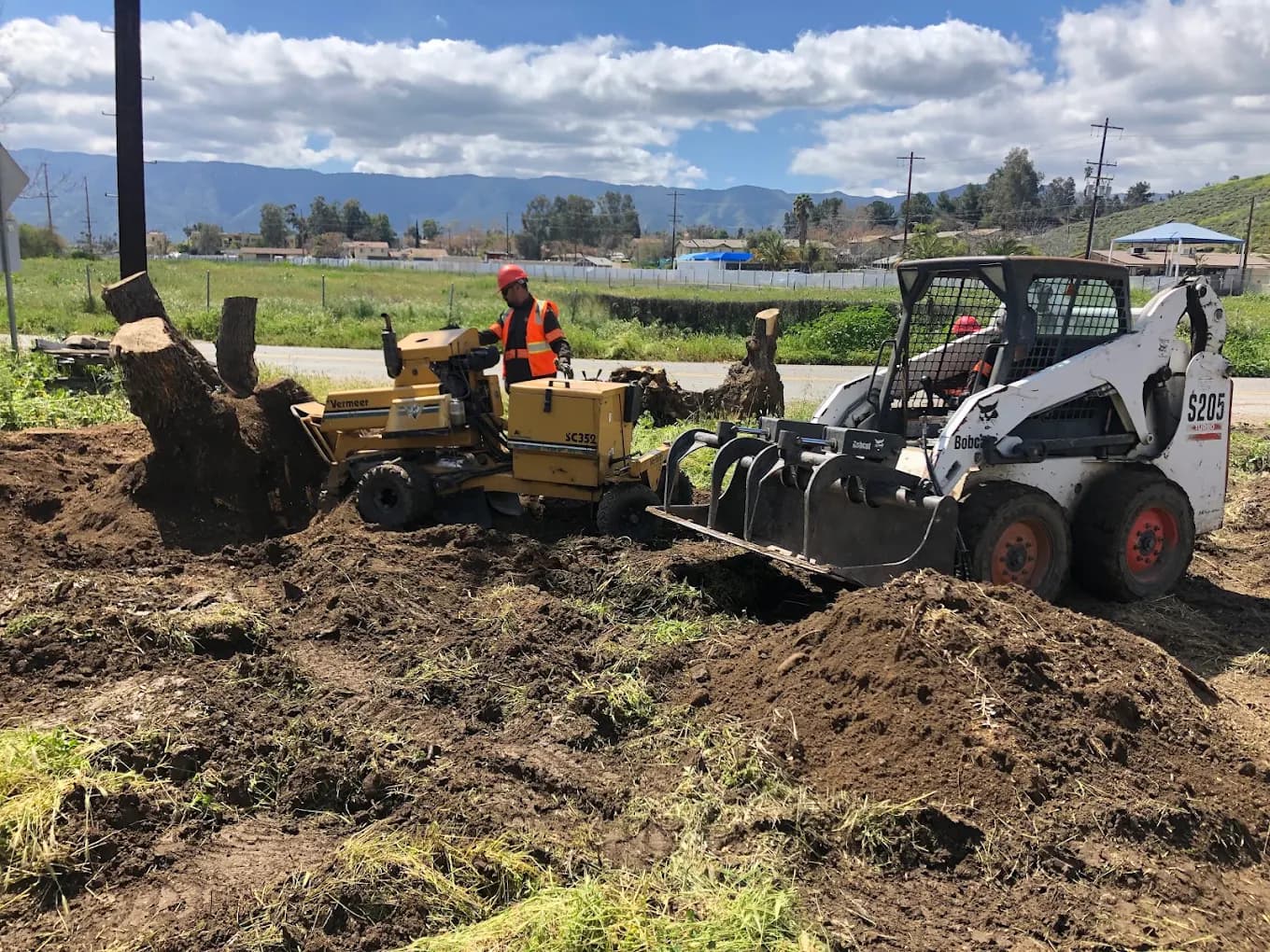
What happens to the stump
Cut close to grade as standard, or ground out 6–12 inches below grade when that is quoted with the tree removal, which costs less than bringing a grinder back on a visit of its own. Anything below grade means the utilities get located first — 811 / DigAlert, under Government Code 4216.2 — because irrigation, cable and gas all sit at grinding depth.
What happens to the wood
Chipped and hauled away, included rather than extra. Cut to firewood lengths and stacked instead is a different job for the crew, so say so at the estimate rather than on the day.
Permits sit outside all of this. Where one is needed on a job it is named as a cost of its own rather than folded into the total, and filing it is the property owner's responsibility rather than ours.
The 9 kinds of tree removal we do
What the tree is doing decides the method, the equipment and the order the crew works in — standing, leaning, dead, or already down are four different jobs sharing one word. These are the nine that come up, and the first thing an arborist establishes is which one is in front of them.
Book a free assessmentLarge Tree Removal
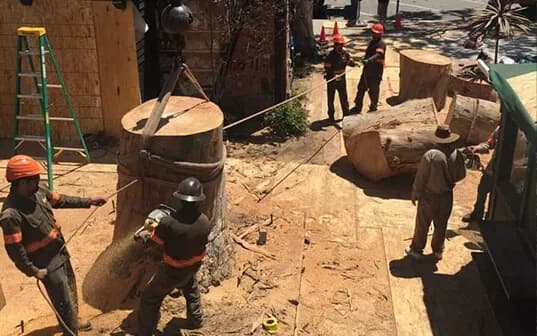
Anything too big to fell in one piece comes down in sections from a 75-foot boom truck, each one lowered on ropes to a crew working the ground. The size of the piece is set by what the rigging point holds, not by what the saw cuts.
Crane-Assisted Tree Removal
For trees over a roof, a pool or a neighbor's property, where nothing can be dropped at all. The crane takes the weight of each section before the cut is finished, so the wood never travels.
Dead Tree Removal
Dead wood is brittle and it fails without warning, which is why a dead tree is worked from a machine rather than climbed. The longer it stands, the less of it can be trusted to hold a rigging point.
Hazardous Tree Removal
Judged on two things at once — how likely the tree is to fail, and what it lands on if it does. A leaning pine over open ground and the same pine over a bedroom are one tree and two different jobs.
Leaning Tree Removal
A lean that appeared after heavy rain is the one that matters — it means the root plate has moved, and a tree standing on a lifted plate has already started to fail. A lean the tree has always had is usually structural, and usually stays.
Storm-Damaged & Fallen Trees
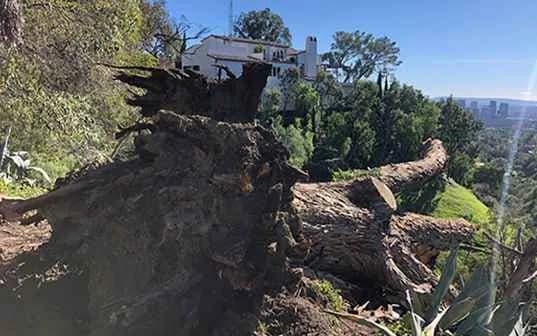
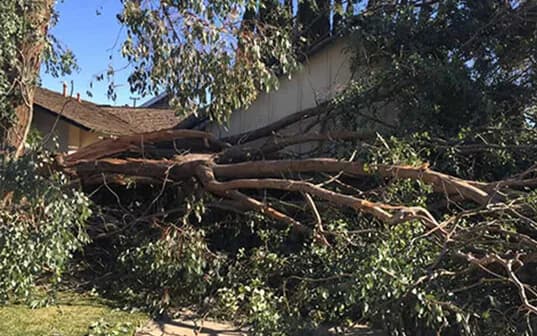
A tree already down is loaded — limbs in tension and compression that move the moment they are cut. Most of what comes down here arrives in one of two windows: the Santa Ana winds, which the National Weather Service puts at September through May, and the saturated ground after a winter storm. The sequence matters more than the saw does, which is why this is the one job never to start yourself.
Diseased Tree Removal
Blades are cleaned between trees and the material leaves the site the same day where a pathogen is the reason. Infected wood stacked in a corner of the yard is how a problem that was one tree becomes three, and a saw that was not cleaned is how it reaches the next street.
Crown Reduction Instead of Removal
A tree too big for where it stands is a reduction job, not a removal one, and you get told that at the estimate. Removal only wins where reducing it every few years costs more across a decade than taking it out and replanting once.
Commercial & Common-Area Tree Removal
On a shared property the removal is the straightforward half and the approval is not. Scope is priced line by line so a board or a manager can sign it off, and the work is booked around residents and access.
Why hire Supreme Tree Experts for tree removal
Tree removal is the riskiest work done on a home lot. Before any cut, an arborist checks the trunk, the root plate and what sits below. Sometimes the answer is that the tree can stay. Where the drop zone is tight, limbs are rigged down on ropes over the roof, the fence or the pool.
The price is written on site, not given over the phone. Chipping and hauling are included, and the site is raked clean before the crew leaves. Where a permit applies, it is listed as its own cost. Filing it is the owner's job, not ours. We do not remove city trees.
ISA Certified Arborist
An ISA Certified Arborist leads each removal. The arborist reads the trunk, the root plate and the drop zone, then decides how each section comes down.
Licensed, Bonded & Insured
CA license #1002853 covers C-27 Landscaping and C-61/D-49 Tree Service. We are bonded, carry general liability, and every employee has workers' comp for high-risk removals.
Southern California Since 1985
We have taken down trees across Southern California since 1985. We know the dry wind season and how soaked winter ground loosens a root plate.
Our Own Equipment
Our own 75-ft boom trucks lower big trees in sections. Our chippers clear the brush, and our stump grinders take the stump out on request.
How a tree removal runs, from first call to final rake
- 01.
Assessed by an arborist
An arborist drives out from our yard, walks the tree, checks the trunk and the root plate, identifies the species and works out whether it has to come out at all. You get a written price for the work.
- Free on-site visit
- Assessed before it is priced
- 02.
Rigged, or lifted by crane
Where the drop zone will take the wood, the tree is felled and sectioned. Where it will not, limbs are rigged down under control or lifted out by crane over the roof, the fence or the pool.
- Our own 75-foot boom trucks
- Ground and planting protected
- 03.
Chipped, hauled and cleared
The trunk is cut into sections, the brush is chipped into our trucks and the site is raked clean. All of it leaves on our trucks rather than going into a green waste cart, which holds a fraction of what one mature tree produces.
- Debris chipped and hauled away
- Stump ground out on request
What to check before you let anyone take a tree down
Removal is the highest-risk work anybody does on a residential property, and the cheapest quote is where most of the damage stories start. Five questions, whoever you end up hiring.
Ask for the license number, then look it up
Tree work is contracting in California — Business and Professions Code 7026.1 names removal, pruning, stump removal and cabling — so the company doing it needs a license. The classification is C-49 Tree and Palm, which replaced C-61/D-49 Tree Service for new applicants on 1 January 2024; a license issued before that date still reads D-49 and is still valid, so do not treat the older code as a red flag. The number belongs on the estimate, and the Contractors State License Board tells you in seconds whether it is live, what it covers and whether anything has been filed against it. A contractor who does not hand the number over has already answered the question.
Ask who carries the workers' compensation
An injured worker on an uninsured contractor's crew can be treated as your employee, and the claim then goes to your homeowner's policy. California Labor Code 3700 requires the cover, so a contractor without it is uninsured by choice. It is the most expensive item on this list to get wrong and the one fewest people ask about.
Get the price on site, in writing
A number given over the phone is a number given without seeing the drop zone, the access or the condition of the trunk. It gets revised on the day, which is the moment you have the least room to argue. Ours costs nothing, and a company that charges to look at a tree is telling you something.
Ask what happens to the wood and the stump
Those are the two lines quietly left out of a cheap quote. Chipping and hauling is a truck and a crew; leaving a stump cut to grade is not the same as grinding it out. Get both in writing before you compare two numbers, because otherwise you are not comparing the same job.
Ask whether they top a tree on request
The right answer is no, and a company that tops one tree because a customer asked tops yours too. Topping leaves a stub the tree cannot close over, so decay runs down from the cut and the regrowth around it is fast, dense and weakly attached.
Where we work across Southern California
5 counties — Orange, Los Angeles, San Diego, Ventura and Santa Barbara — worked by crews running out of Santa Ana. These 7 areas are where most of it happens. Call 877-787-7363 if you are not sure whether your address falls inside them.
See every town we serveRecent tree removal jobs
Real photos and videos from our own job sites. Tap any one to see it full size.
Real reviews, straight from our Google profile
Every word below was written by a customer on Google, not by us. Long reviews are shortened to fit the card — never reworded — and the full list is one click away.
“Great pricing & service. Highly competent with tricky jobs. We have used them for more than 10 years.”
Melanie Butler
Local Guide
“We got bids from five contractors. After I talked to them all and checked out their licenses and work, we decided to go with Supreme. … The job took a day and a half, and when they were done, they left the place immaculate.”
Hank Shaeffer
“Great tree trimmers! I’ve used Supreme Tree Experts twice to trim the palm trees in my yard. … The guys who come out are quick thorough, and clean. And very careful not to damage property.”
Emilie Pacheco
“These guys have worked on my property 3 times now. They are always on time and do a fantastic job. I highly recommend them!”
Ray Thompson
“After soliciting several quotes on some difficult yard work, we chose Supreme because of their licensed Arborist Temis … The crew was extremely hard working and we couldn’t believe their continuous work ethic on one of the hottest days of the year.”
Gary Brown
Local Guide
“Had them take out some tall eucalyptus trees on my lot in Hollywood. Great service. Fast, friendly and professional.”
Kirk Lee
Local Guide
Tree removal questions from property owners
Insurance, a neighbor's tree, doing it yourself, the roots and the right month — six that the rest of this page does not already answer. If yours is not here, call 877-787-7363 and ask.
Usually only once the tree has already hit something the policy insures. A healthy tree taken down because you want it gone is maintenance, and maintenance is not a claim. A tree that comes through a roof, a fence or a garage in a storm normally is — though most policies cap what they pay toward the removal itself. Photograph everything before anything is moved, and read your own policy rather than assuming either way.
Liability follows negligence, not the property line. Ownership decides who may remove a tree; it does not decide who pays when one fails. A healthy tree brought down by a wind event is normally each owner's own insurer — nobody was at fault. A tree that was visibly dead, or that the owner had been told about in writing beforehand, is a different conversation, because at that point the failure was foreseeable. Photograph everything before it is moved, and raise a concern about a neighbor's tree in writing before it comes down rather than after.
A small one, yes. Anything near a structure, a fence or a line, no — and the reason is not the saw. Professional work runs to ANSI Z133 for drop zones, rigging and electrical clearance, and in California to Cal/OSHA Title 8, sections 3420 to 3428, which is the one with legal force behind it. The jobs that go wrong are the ones where a limb went somewhere nobody had planned for. A licensed tree cutting service also carries insurance for the part that goes wrong; a homeowner's policy generally does not cover you falling off your own ladder holding a chainsaw.
They stay in the ground and break down on their own, over years rather than months, and that is normally harmless. Two things are worth knowing. Some species — liquidambar, poplar and elm among them — push suckers up from those roots for a year or more afterward, and those get cut back rather than treated. And roots sitting directly under a planned patio or footing are a separate question: raise it at the estimate, because it decides whether grinding is enough or the root plate has to come out.
A hazardous tree comes out the week you find it, in any month. Season only matters for trees that are not a hazard. Ground is firmest in late summer and early fall, which means less damage from equipment crossing a lawn. Nesting birds are protected under the Migratory Bird Treaty Act, so an active nest moves the date rather than the method. And the National Weather Service puts Santa Ana wind season at September through May, and that nine-month window is when the trees that were going to fail do.
This one is. California license #1002853, bonded, general liability, and workers' compensation on every employee. Ask any contractor for their license number and check it on the CSLB website before work starts — on a job this close to a roof it is the only thing standing between you and the bill.