Tree Height Reduction in Santa Ana & Southern California
Taking height and spread off a canopy with reduction cuts, to ANSI A300, from our base in Santa Ana, CA across the five counties we cover. It is the opposite of topping, and the difference in the cut is why one tree recovers and the other does not.
Tree Height Reduction
Crown reduction versus topping
A reduction cut goes back to a lateral branch big enough to take over as the new leader. A heading cut does not. That is the entire difference between crown reduction and topping. The current ANSI A300 pruning standard puts a working figure on big enough — typically a third the diameter of the stem removed — and phrases it as guidance rather than as a rule, because species and position move it. The lateral takes over, the wound closes, and the tree holds a shape it can carry.
We never top a tree. It is the one job we turn down.
When taking height off is the right call
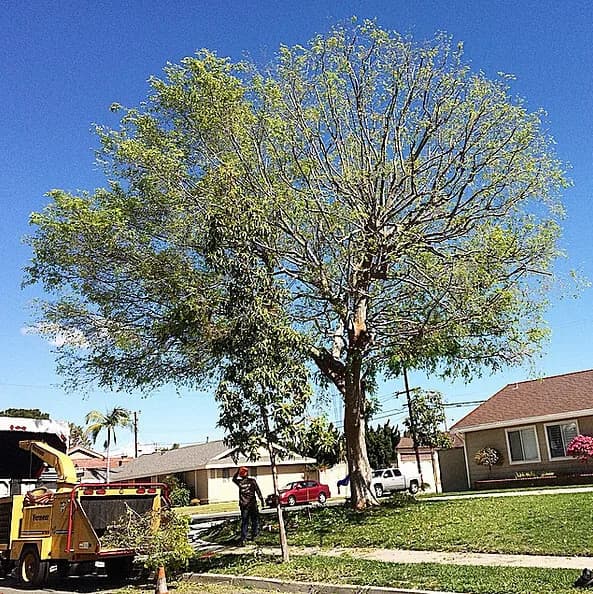
Reduction is worth doing when the tree can carry the loss and the problem is genuinely the size. It is worth refusing when neither is true, and on any property an arborist ought to tell you plainly which of the two you have.
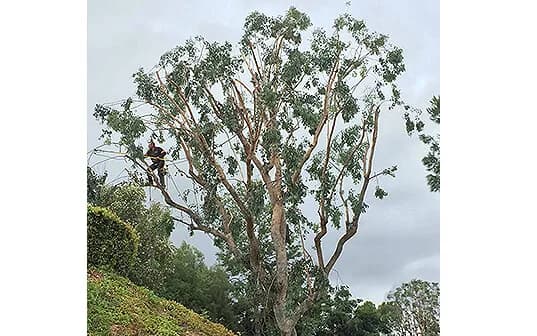
It has outgrown its position over a roof — the canopy is now over the structure rather than beside it, and the limbs reaching furthest are the ones that fail first
The crown has got top-heavy — weight high in a tree is leverage on the roots every time the wind blows, and Santa Ana season is when that gets tested
It is into a sight line or a view — the one reason on this list that is purely yours, and a perfectly reasonable one
Limbs are over-extended and starting to droop — reach without taper, which is a limb telling you it is carrying more than it was built to
It is shading out everything underneath — grass, planting and windows that have not seen direct light in years
Storm damage has left it lopsided — reduction is how the remaining crown gets rebalanced rather than left loaded on one side
And when it is the wrong call: a tree needing a third of its height taken off to be safe has outgrown its position permanently. Reducing that tree every few years costs more across a decade than removing it once and planting something that fits the space.
How much does crown reduction cost in Southern California?
It starts at the $600 tree-services minimum, and above that floor it is the height, the species and how much is coming off — in that order. Reduction is slower work than a straight trim, because every cut has to be chosen rather than simply made, and the crew is working at the top of the tree rather than through it.
The 6 things a reduction is priced on
Height and how the crew gets up there
Rope and harness, boom truck or crane. The method is decided by the tree rather than the budget, and it is the single biggest line in the difference between two quotes on the same tree.
How much is coming off
A light reduction to clear a roofline and a full proportional reduction of the whole crown are different days, and the second is most of a day on a mature tree where the first is a couple of hours.
Species and how it responds
Some species reduce cleanly and hold the new shape. Others respond with vigorous regrowth and will need doing again sooner, which is worth knowing before rather than after.
Condition of the tree
A stressed or declining tree may need the work staged across two or three seasons rather than done at once — which costs more in total and is still the right answer where it applies.
What is underneath the drop zone
Every piece over a roof, a pool or a neighbor's fence has to be rigged down under control rather than dropped. Controlled is slower, and slower is the price.
Volume of brush to clear
A reduction generates far more small material than a removal does for the same tree, because it is all twig and leaf. Chipping and hauling is included; the volume still shows in the day.
Reduction, thinning, lifting and overhang work
These six get used together and they are not interchangeable. Crown reduction is also called tree crowning or drop crotching — same operation, three names, and the one most often confused with topping on a quote.
Book a free assessmentCrown reduction
Height and spread brought in proportionally, every cut going back to a lateral big enough to take over. The tree keeps its own outline at a smaller size rather than gaining a flat top.
Progressive reduction
The same work staged across two or three seasons, for a tree without the stored energy to take it in one go. The first cut lets new growth establish below it, so the second cut has something to reduce back to.
Crown thinning
Selected branches removed throughout the canopy so wind and light move through it, without changing the height or the spread at all. Often the answer when somebody asks for reduction and the real problem is density.
Crown lifting
Lower limbs removed up to an agreed height, which lightens the foliage and lets the remaining branches sit higher. The live crown stays at roughly two-thirds of the tree's height.
Overhang and reach reduction
Excess reach taken off individual limbs while the silhouette stays balanced. This is the targeted version — the tree keeps its size and loses only the parts that are going somewhere they should not.
Canopy volume reduction
Quoted as a percentage of the outer canopy — the small branch and twig layer — rather than as a height in feet. It is how a proportional reduction is specified and agreed before anybody leaves the ground.
Reduction cut against heading cut
One thing separates them: whether the cut goes back to a lateral branch big enough to take over as the new leader — a third the diameter of the stem removed being the figure the standard suggests for it. Everything that goes wrong after a topping comes from the absence of that lateral.
Reduction cut
What we doHeading cut, or topping
What we will not doIn Santa Ana, CA, where we are based, topping a public tree is unlawful as a normal practice — those are the words of SAMC 33-190 — and the code puts a number on the word at 33-182: cutting limbs back to stubs larger than three inches in diameter within the crown, far enough to remove the normal canopy and disfigure the tree. No ordinance reaches a tree in your own back yard, and we hold the same line there anyway. A company that will top one tree because a customer asked will top yours.
Why Supreme Tree Experts for tree height reduction
We never top a tree. It is the one job we turn down. Every reduction cut goes back to a side branch big enough to become the new leader. That follows ANSI A300. The tree keeps its own outline at a smaller size instead of a flat top.
An arborist first checks how much height the tree can lose in one season. We take no more than a quarter of the live canopy at once. If reduction does not solve your problem, we tell you plainly. Afterward, the shape is checked from the ground and the brush is hauled.
ISA Certified Arborist
An ISA Certified Arborist leads the work. The arborist finds the side branches to cut back to and says whether reduction is the right call.
Licensed, Bonded & Insured
CA license #1002853 covers C-27 Landscaping and C-61/D-49 Tree Service. We are bonded, carry general liability, and every employee has workers' comp for work at the treetop.
Southern California Since 1985
We have reduced trees across Southern California since 1985. A top-heavy crown puts leverage on the roots, and the wind season tests it each year.
Our Own Equipment
Our own 75-ft boom trucks put the crew at the top of the crown. Our chippers clear the twig and leaf that reduction produces.
How height comes off safely
- 01.
Canopy read from the ground
An arborist drives out to the property, works out where the laterals are, how much height the tree can lose in one season, and whether reduction actually solves the problem you called about.
- Free on-site assessment
- Told plainly if reduction is wrong
- 02.
Cut back to laterals
Every cut goes back to a lateral big enough to take over, worked around the whole canopy so the tree keeps its outline instead of gaining a flat top.
- ANSI A300 reduction cuts
- A quarter of the live canopy in a season
- 03.
Shape checked, site cleared
The crew comes down, the shape is read from the ground and corrected where it needs it, and the brush is chipped and hauled.
- Outline checked from the ground
- Full clean-up included
Where we work across Southern California
5 counties — Orange, Los Angeles, San Diego, Ventura and Santa Barbara — worked by crews running out of Santa Ana. These 7 areas are where most of it happens. Call 877-787-7363 if you are not sure whether your address falls inside them.
See every town we serveRecent tree height reduction jobs
Real photos and videos from our own job sites. Tap any one to see it full size.
Real reviews, straight from our Google profile
Every word below was written by a customer on Google, not by us. Long reviews are shortened to fit the card — never reworded — and the full list is one click away.
“Great pricing & service. Highly competent with tricky jobs. We have used them for more than 10 years.”
Melanie Butler
Local Guide
“We got bids from five contractors. After I talked to them all and checked out their licenses and work, we decided to go with Supreme. … The job took a day and a half, and when they were done, they left the place immaculate.”
Hank Shaeffer
“Great tree trimmers! I’ve used Supreme Tree Experts twice to trim the palm trees in my yard. … The guys who come out are quick thorough, and clean. And very careful not to damage property.”
Emilie Pacheco
“These guys have worked on my property 3 times now. They are always on time and do a fantastic job. I highly recommend them!”
Ray Thompson
“After soliciting several quotes on some difficult yard work, we chose Supreme because of their licensed Arborist Temis … The crew was extremely hard working and we couldn’t believe their continuous work ethic on one of the hottest days of the year.”
Gary Brown
Local Guide
“Had them take out some tall eucalyptus trees on my lot in Hollywood. Great service. Fast, friendly and professional.”
Kirk Lee
Local Guide
Height and crown reduction questions from property owners
Whether height can be capped at all, overhanging limbs, leaning trees and spotting a tree that was topped before — six the sections above do not already answer. If yours is not here, call 877-787-7363 and ask.
No. Nothing stops a tree growing — it can only be kept down. Trees do not reach a mature size and halt the way most organisms do; they keep adding height for as long as they are alive. What reduction does is hold a tree at a workable size, which means repeating it. Wanting a tree 8 feet shorter usually means taking around 2 feet a year over several seasons rather than 8 feet at once, because the tree cannot carry that loss in one go.
In California you may generally trim what crosses the boundary, at your own expense, back to the property line — and no further. What you may not do is cut in a way that damages or kills the tree, because the tree still belongs to whoever owns the land its trunk stands on, and killing it can make you liable for its value. Talk to the neighbor first, and get an arborist to make the cuts: a boundary line is not a pruning point, and a limb cut arbitrarily at a property line is exactly the cut that causes the damage.
No, and it can make the diagnosis harder. A lean is almost always a root problem or a soil problem, and taking weight off the top does not put the root plate back. Reduction may buy time on a tree that is leaning because it grew that way toward light. On a tree that started leaning recently, the lean is the symptom and the roots are the question — that is an assessment before it is a pruning job.
Yes, in time. Reduction manages a tree rather than fixing it permanently, so it is done on a cycle — usually every few years, agreed when the work is first quoted.
Yes. Rigging controls where each piece lands, and where the drop zone is too tight even for that, a crane lifts the wood out over the roof. The rigging and the boom trucks are our own, which is what makes scheduling them practical.
Look for knuckles. A topped tree carries swollen, knobbly ends where the old stubs were, with a dense cluster of same-age shoots erupting from each one instead of a branch that tapers. The crown looks thick from a distance and hollow from underneath. It can usually be managed — restoration pruning selects the strongest shoot at each knuckle and removes the rest over several seasons — but the attachments are never as strong as the originals, which is worth knowing if the tree stands over anything.