Hardscape Contractor in Santa Ana & Southern California
Based in Santa Ana, CA, we build patios, pavers, retaining walls, steps and fire features across the five counties we cover — and we look at the roots and the falls before anything is laid.
Hardscape
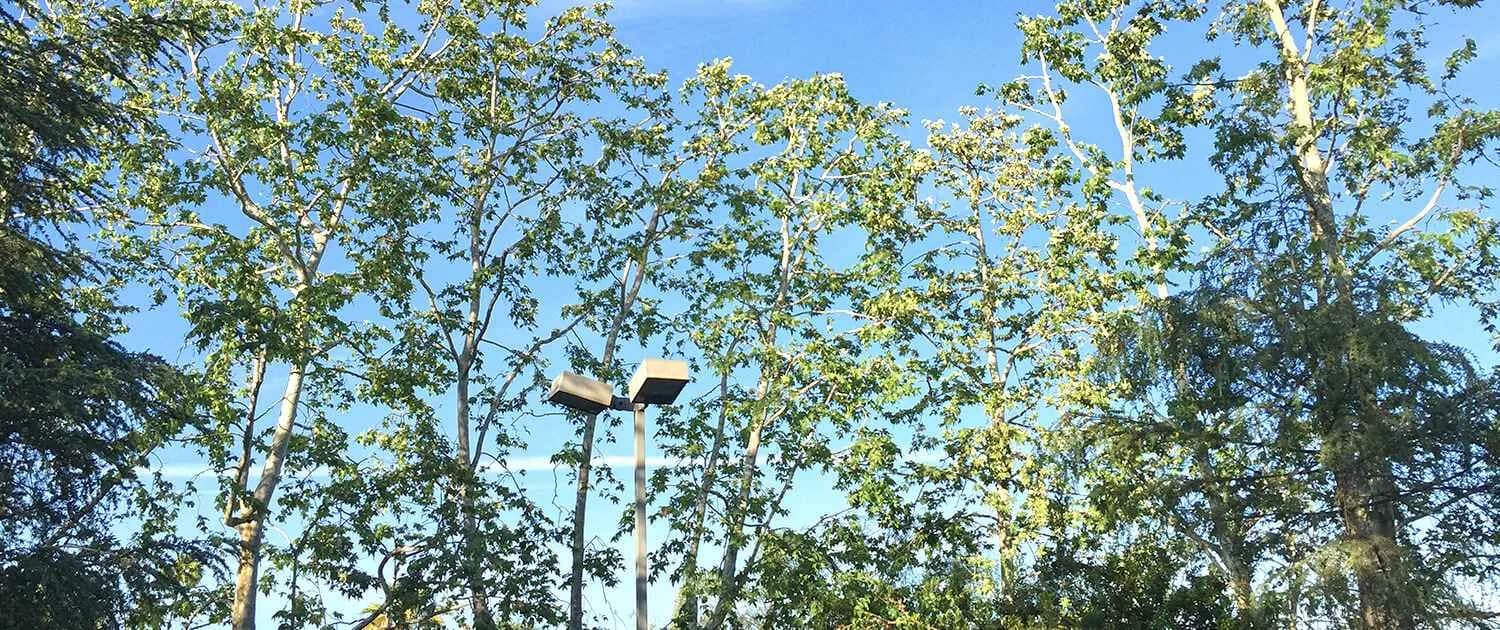
Why a patio starts with the trees
Because roots and paving destroy each other, and they do it slowly enough that nobody connects the two. A root thickens under a slab and lifts it. A slab laid over a root plate cuts off the water and air the tree was living on. On an older lot both bills arrive years after the work, and both are avoidable at the planning stage for nothing.
When a property needs hardscape rather than more planting
Most hardscape is bought to solve a problem, not to add a feature. The patio and the fire pit are the part people picture. The reason an owner picks up the phone is usually something outside that stopped working.
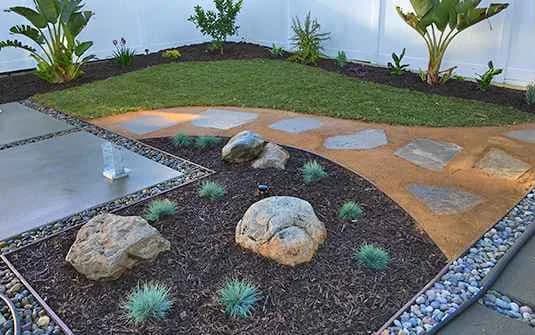
There is a strip of dead lawn where everyone walks — grass loses to footfall every time, and the worn line is the path the property has been asking for
Paving has lifted and become a trip hazard — on a mature lot this is nearly always a root thickening underneath, and relaying it without dealing with the root buys about four years
Soil is moving down a slope — beds washing out and mulch collecting at the bottom of the hill is a retaining problem, and it gets more expensive every winter
Water pools in the same spot after every rain — a low point that will not drain, which paving can fix or make permanent depending entirely on who lays it
Half the yard is unusable because of the grade — ground too steep to put a chair on is space you pay property tax on and cannot stand on
There is more lawn than anyone uses — replacing the part that is only looked at cuts the irrigated area and the mowing in one afternoon, which in a Southern California summer shows up on the water bill
One of those is not a hardscape job. Where water pools because the ground falls the wrong way, paving over it relocates the problem rather than solving it — grading and drainage come first, and a contractor quoting paving without raising them is quoting the wrong job.
Paving materials, and what each asks afterward
The material sets the look on day one and the upkeep for the next twenty years. Most of the choice is a trade between what a surface costs to lay and what it costs to leave alone afterward, and the second number is the one that never appears on a quote.
Concrete pavers
Maintenance: Low maintenanceManufactured units on a compacted base, laid dry and locked together with joint sand. The most forgiving surface here — it flexes with ground movement instead of cracking, and a single unit can be lifted and reset.
Poured concrete
Maintenance: Low maintenanceOne continuous slab, the cheapest square footage on this list and the quickest to lay. It also cracks eventually: control joints decide where, not whether, and a repair never quite matches.
Stamped concrete
Maintenance: Higher maintenanceA poured slab pressed with a pattern and colored while wet. Reads as stone at a slab price, and wants resealing every few years or the color goes flat and the pattern grays out.
Porcelain
Maintenance: Low maintenanceThrough-body porcelain slabs on pedestals or a bedding layer. Non-porous, so it neither stains nor fades and never needs sealing at all. Wood-look and stone-look finishes are convincing now and the price has come a long way down.
Brick
Maintenance: Moderate maintenanceClay units in a running or herringbone bond. Ages better than almost anything else on this list, and the joints are where the work is — they want topping up, and they grow weeds if they are left.
Bluestone
Maintenance: Moderate maintenanceDense blue-gray sandstone, cut square or laid as irregular flags. A cool-toned, formal surface that holds up well and is priced accordingly.
Flagstone
Maintenance: Moderate maintenanceIrregular natural slabs with wide joints. Sand-set is informal and can be planted into; mortar-set is formal and cracks wherever the base beneath it moves.
Cobblestone
Maintenance: Moderate maintenanceSmall squared setts, usually as banding, edging or a driveway apron rather than a whole surface. Extremely durable and uneven underfoot — a feature in some places and a hazard in others.
Decomposed granite
Maintenance: Higher maintenanceCompacted stone fines, the informal path surface all over Southern California. Cheap, permeable and genuinely useful over a root zone — it also tracks indoors, ruts in a downpour and wants topping up every few years.
Stepping stones
Maintenance: Low maintenanceIndividual slabs set into gravel, planting or lawn. The cheapest way to make a route official, and the correct answer to a worn line across the grass.
River rock
Maintenance: Low maintenanceRounded cobble used as a dry creek, a drainage margin or an edging band rather than a walking surface. It does a drainage job while looking like a decision.
Sealing is the line item people forget, and it is not universal. Porcelain never needs it and poured concrete rarely does, but stamped concrete, brick and most natural stone want resealing on a cycle — and over twenty years that can cost more than the gap between two materials at the quoting stage. Worth asking what a surface needs in year three before choosing it in year one.
How much does hardscape cost?
Square footage times the material, plus everything that goes underneath it. The surface is the part compared between quotes and the smaller half of the bill. Excavation, base, drainage and access decide the rest, which is why two quotes for the same patio can look nothing like each other.
The 6 things hardscape is priced on
Area, and the shape of it
Square footage first, but a complicated outline costs more per foot than a simple one. Every curve and every angle is a cut, and cuts are labor plus waste on material that was bought by the pallet.
The material
The spread between poured concrete and cut natural stone is the widest single variable here, and unlike most of this list it applies to the entire area rather than to one part of the job.
What is there now
An old slab, a failed paver field, a stump, compacted clay or bare soil. Demolition and haulage of existing concrete is effectively its own job, done before the new one starts.
Base depth and compaction
How deep the base goes depends on the soil and on what will stand on it — a patio and a driveway are not the same excavation. This is the line that varies most between contractors, and the one that decides whether the surface is still flat in ten years.
Level changes
Steps, terracing and retaining. A flat area is priced by the foot; a change in grade is priced as a structure, because a wall holding ground back is exactly that.
Access
Whether a machine reaches the work, or every ton of base and every pallet of stone goes through a side gate in a wheelbarrow. On a back yard behind a 36-inch gate, access can cost more than the material does.
The $600 minimum is on tree services and does not apply here — built work is quoted on the job itself. Where trees, planting and hardscape are all in scope, the estimate covers all three and still costs nothing.
Patios, walls, steps and fire features
Everything here is laid on a base rather than planted into soil, which is what makes it a different trade from the landscaping around it. Six things get built most often on a property, and every one of them changes where water goes — so none of them is decided on its own.
Book a free site visitPatios and paving
The main surface — pavers, poured or stamped concrete, porcelain or natural stone, on a base cut to suit the soil and the load above it. Laid to a fall rather than dead level, because a patio that holds water is a patio that grows algae.
Walkways, steps and stepping stones
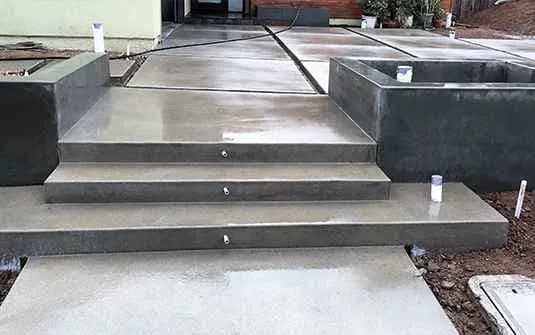
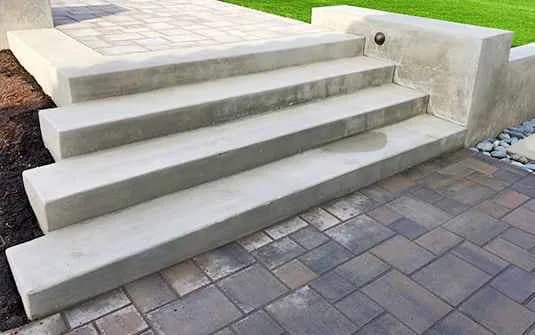
The routes between parts of a property and the level changes in between. A flight has to hold one riser height the whole way up — uneven risers are the commonest trip hazard on a residential property, and the hardest to retrofit out.
Retaining and seat walls
Walls that hold ground back, and walls that give you somewhere to sit. The first kind is a structure with drainage behind it and a footing under it, and it is the item on this page most likely to need a permit.
Outdoor kitchens, bars and fire features
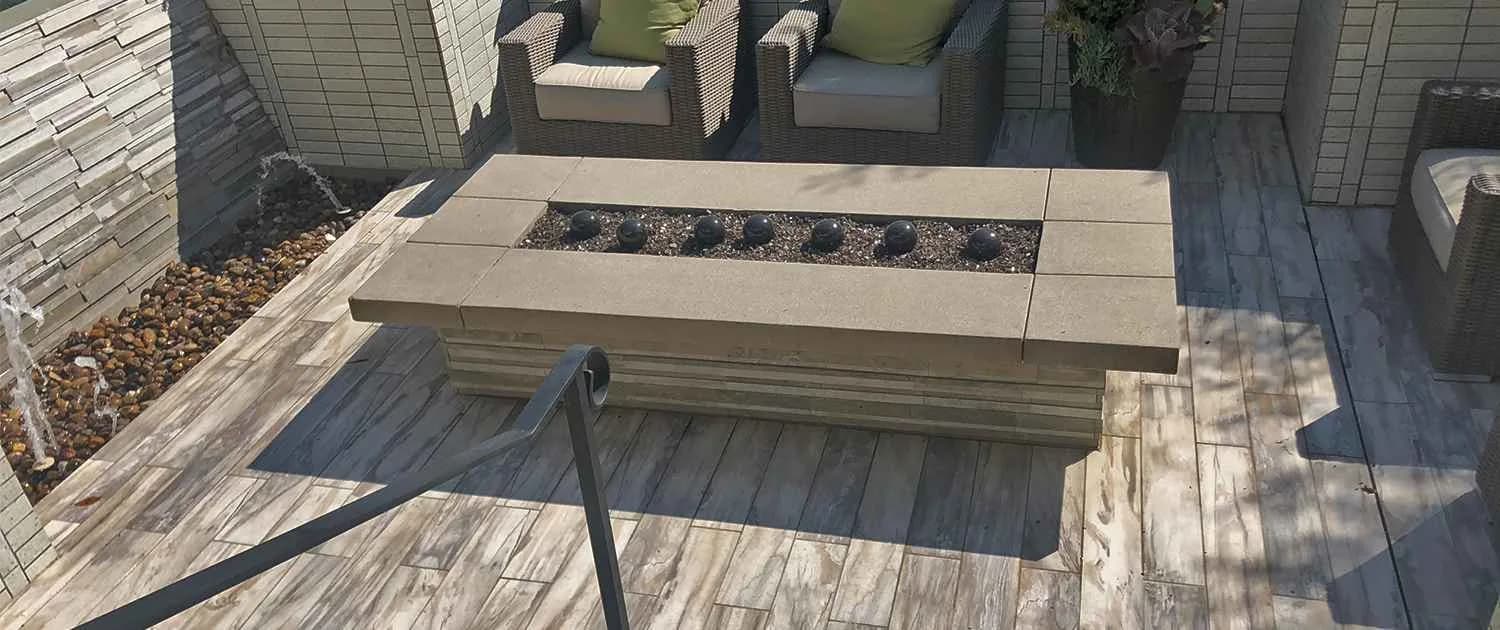
Built-in BBQs, bars, counters and fire pits. The build itself is masonry; what decides the layout is where gas, water and power can reasonably come from, which is worth settling before any slab goes down.
Natural stone features
Boulders, dry-stack walling, stone veneer and dry creek beds. The part of a hardscape that makes it look like it was always there rather than delivered on a pallet last Tuesday.
Drainage built into the surface
Falls, channel drains, permeable joints, and where water goes once the ground stops absorbing it. Every square foot of paving is a square foot that no longer drains, so this is designed in rather than added once it turns out to be needed.
Why Supreme Tree Experts for hardscape near mature trees
Roots and paving damage each other slowly. A thickening root lifts a slab, and a slab over a root plate starves the tree. So before anything is laid, the trees are assessed and their root zones located. We also measure where water flows now.
The base is laid and compacted in layers, not in one go. Every patio is laid to a fall so water drains away. Edges are restrained on every run. If a root has to be cut, an arborist decides it. The site is left clean.
ISA Certified Arborist
An ISA Certified Arborist checks the trees before we dig. The arborist maps the root zones and decides any root cut, to keep the tree stable.
Licensed, Bonded & Insured
CA license #1002853 covers C-27 Landscaping and C-61/D-49 Tree Service. We are bonded, carry general liability, and every employee has workers' comp for excavation and heavy lifting.
Southern California Since 1985
We have built around mature trees across Southern California since 1985. We lay surfaces that shed winter rain away from the house.
Our Own Equipment
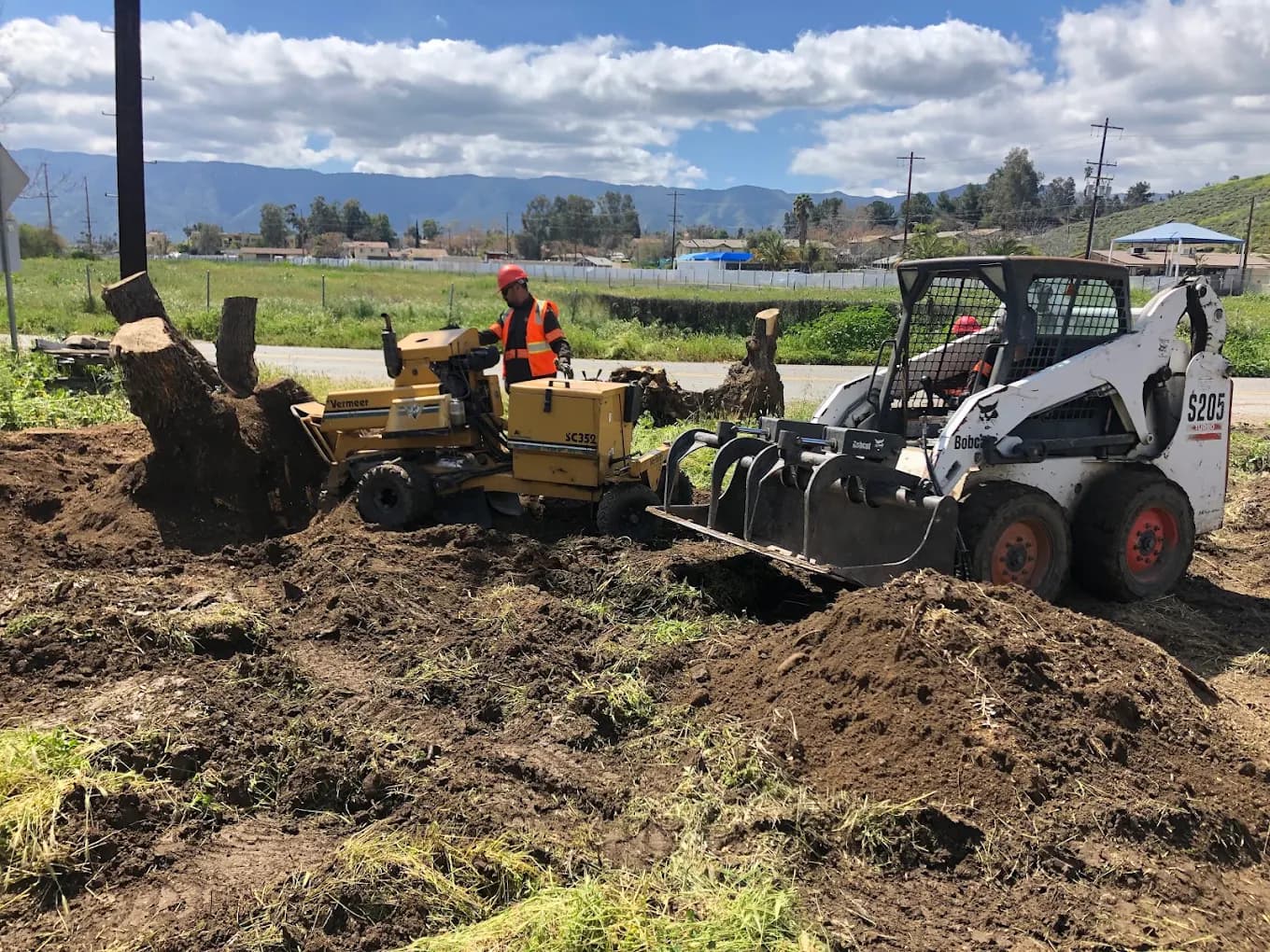
Our own bobcats dig out the site and move base material. Our haulers remove old slabs and soil, so demolition needs no second contractor.
How hardscape work is planned
- 01.
Roots located, falls measured
Before anything is set out on a site, the trees are assessed, their root zones are located and the falls are taken — where water goes now, and where it needs to go instead.
- Free on-site visit
- Root zones and falls mapped
- 02.
Dug out, based and compacted
Excavation, then base material laid and compacted in layers rather than in one go. Any root that has to be cut is cut by someone who knows what the cut costs the tree.
- Base compacted in layers
- Root cuts decided by an arborist
- 03.
Laid, jointed and cleaned down
The surface goes on, every edge is restrained, joints are filled and the planting around the work is made good. Nothing is left behind for a landscaper to sort out afterward.
- Edges restrained on every run
- Site left clean
How to judge a hardscape quote
Two quotes for the same patio, in the same material, at the same square footage, can differ by half — and the cheaper one is not necessarily wrong. These six questions are what the difference usually turns out to be. They are as useful for checking us as for checking anybody else.
Ask how deep the base goes, in inches
A real answer is a number and a reason: how deep, what material, and compacted in how many layers. A patio and a driveway do not take the same base, and clay does not take the same base as sand. An answer along the lines of "the usual" is the single biggest predictor of a surface that moves.
Ask how the edges are restrained
A dry-laid surface is held together at its perimeter, and paving with nothing at the edge spreads outward and opens its joints from the outside in. Edge restraint is cheap, invisible and the thing most often left out of a low quote.
Ask where the water goes
Every surface needs a fall and somewhere for the water to end up. If the answer is that it will drain away, ask where. New paving that sheds rain toward a building is a considerably worse problem than the one it replaced.
Ask whether anyone looked at the trees
Roots under a planned surface, and a planned surface over a root zone, are two separate problems with two different answers. Neither is visible in a drawing. A quote produced without anybody walking the trees has not priced either of them.
Ask who is pulling the permit, if one is needed
Retaining walls above a certain height need one, and requirements vary by city. Establish who is responsible for it before work starts rather than after an inspector has seen it — retrofitting a wall to a code requirement means taking it down.
Ask what the warranty actually covers
Settlement and cracking are different failures with different causes, and a warranty frequently covers one and excludes the other. On poured concrete, hairline cracking is usually excluded outright — which is fair, and worth knowing before rather than after.
Where we work across Southern California
5 counties — Orange, Los Angeles, San Diego, Ventura and Santa Barbara — worked by crews running out of Santa Ana. These 7 areas are where most of it happens. Call 877-787-7363 if you are not sure whether your address falls inside them.
See every town we serveRecent hardscape jobs
Real photos and videos from our own job sites. Tap any one to see it full size.
Real reviews, straight from our Google profile
Every word below was written by a customer on Google, not by us. Long reviews are shortened to fit the card — never reworded — and the full list is one click away.
“Great pricing & service. Highly competent with tricky jobs. We have used them for more than 10 years.”
Melanie Butler
Local Guide
“We got bids from five contractors. After I talked to them all and checked out their licenses and work, we decided to go with Supreme. … The job took a day and a half, and when they were done, they left the place immaculate.”
Hank Shaeffer
“Great tree trimmers! I’ve used Supreme Tree Experts twice to trim the palm trees in my yard. … The guys who come out are quick thorough, and clean. And very careful not to damage property.”
Emilie Pacheco
“These guys have worked on my property 3 times now. They are always on time and do a fantastic job. I highly recommend them!”
Ray Thompson
“After soliciting several quotes on some difficult yard work, we chose Supreme because of their licensed Arborist Temis … The crew was extremely hard working and we couldn’t believe their continuous work ethic on one of the hottest days of the year.”
Gary Brown
Local Guide
“Had them take out some tall eucalyptus trees on my lot in Hollywood. Great service. Fast, friendly and professional.”
Kirk Lee
Local Guide
Hardscape questions
Concrete against pavers, permits, building over roots, how soon a surface can be used, and upkeep — six the sections above do not already answer. If yours is not here, call 877-787-7363 and ask.
Pavers where the ground moves or there are trees anywhere near; poured concrete where budget is the constraint and the area is open. Concrete is the cheapest square footage and the quickest to lay, and it is one rigid piece — which is its whole advantage and its whole problem. It cracks eventually, control joints only decide where, and a repair stays visible. Pavers cost more up front and go down as individual units on a compacted base, so the surface flexes with ground movement instead of fracturing, and any single unit can be lifted and reset. Near an established tree that difference decides it: a root that lifts a paver is a half-day repair, and the same root under a slab is a new slab.
A patio at grade usually not; a retaining wall over 4 feet almost always. The statewide building code exempts most on-grade paving, and exempts retaining walls up to 4 feet measured from the bottom of the footing to the top of the wall — not from the ground you are standing on, which is where people get caught out. Above that, or at any height where the wall holds a surcharge such as a driveway or a slope sitting above it, a permit and an engineered design are normally required. Cities amend these rules and some are considerably stricter, so the only answer that counts is the one from the building department for your address, whichever city it is in, and the permit is pulled by the property owner. Settle who is pulling it before anybody digs: a wall built to the wrong spec does not get corrected, it gets taken down.
Yes, but not by excavating a base through them in the usual way. Cutting the normal 6 to 8 inches of base out of a root zone severs both the roots holding the tree up and the roots feeding it, and the tree either declines over the following seasons or goes over in a wet winter. The approaches that work build up rather than down: a permeable surface such as decomposed granite or open-jointed pavers over a shallow bed, so water and air still reach the soil, or a raised structure on piers set between roots rather than through them. Either way somebody has to identify where the critical root zone actually is first. Where a solid slab is non-negotiable, the honest conversation is about whether the tree or the patio is the priority, because across that footprint it is rarely going to be both.
Pavers the same day; poured concrete a week or more. A dry-laid paver surface is usable as soon as it is jointed and compacted, which is one of the quieter arguments in its favor. Concrete runs on chemistry instead: foot traffic after roughly 24 to 48 hours, a passenger vehicle after about 7 days, and full design strength at 28 days, which is also when a slab is normally ready to be sealed. Weather moves all three, and cold or damp conditions move them later rather than earlier. Driving onto a slab early is the commonest way a brand new driveway earns its first crack.
It usually means less, provided what is underneath it was built properly. A paved area needs no water, no mowing and no feeding, so every square foot converted from lawn takes work off the calendar rather than adding it — and a defined path keeps footfall off the planting it used to cut across. Weeds in the joints are the exception everyone expects, and they are mostly a symptom rather than a fact of life: correct joint material and restrained edges leave very little for a seed to land in. Where upkeep does come back is in the finish rather than the structure, and that varies enough between materials to be worth checking before choosing one.
Usable outdoor space reads to a buyer as extra living area, and that is the part that moves them. A patio big enough for a table and chairs, a path that reaches it without crossing wet grass, and a slope terraced into ground somebody can stand on all change what a property feels like it contains. Two cautions against that. Highly personal built features — an elaborate outdoor kitchen, a large fixed fire installation — appeal to a narrower set of buyers than a plain, well-built patio does, so they are worth building because you want them rather than as an investment. And hardscape done badly is worse than none at all: cracked, settled or lifted paving is one of the few things in a yard that a buyer reads as a repair bill rather than as a feature.