
Palm Tree Trimming & Skinning in Santa Ana & Southern California
Fan palms, Canary Island date palms and queen palms trimmed from a lift truck from our base in Santa Ana, CA, across the five counties we cover — fronds, seed pods and boots, on a cycle that suits the species rather than the calendar.
Palm Trimming
How often a palm needs trimming
Once a year for most palms, twice for a Mexican fan palm that is dropping seed. Dead fronds, spent flower stalks and seed pods come off; live green fronds sitting above the horizontal mostly stay. Cutting a palm back to a narrow spike removes the food the crown is living on and narrows the trunk permanently at the point it was starved.
A palm cut back to a pencil is not a tidy palm. It is a starved one.
When a palm actually needs trimming
Palms are the one tree people cut too often rather than too rarely, and over-trimming does more damage than leaving it a season. These six are the reasons that justify the visit.
Fronds have gone brown and dry — dead fronds carry no food value to the palm and drop without warning once they let go
Seed pods or flower stalks are out — they get heavy, they stress the crown, and on a Mexican fan palm they seed the whole neighborhood
The crown is loaded on one side — a heavy skirt or a mass of seed is weight the trunk carries off-center, and it is a common reason a palm starts to lean
Fruit or fronds are dropping over a walkway, a driveway or a car — a frond off a 40-foot palm has a long way to gather speed
The skirt has built up against a structure — dead frond thatch holds moisture, houses roof rats and carries fire load next to a wall
It is blocking a view, a light or a sight line — the one reason on this list that is purely yours, and a perfectly good one
What is not on this list: making it grow faster. Frequent trimming does not speed a palm up — it slows it down, and it can kill one outright.
Which palms can be skinned, and which have nothing to skin
A good share of the palms we are asked to skin have no boots on them at all. A palm either holds its dead frond bases on the trunk for years or sheds them as it grows, and that is a species trait rather than a maintenance one — so the first question on an estimate is which of the two is standing in front of us. ANSI A300 calls the operation palm peeling, or shaving, and defines it as taking those dead bases off where they meet the trunk without damaging living tissue.
California fan palm
Can it be skinned: Yes — the classicWashingtonia filifera holds every dead base indefinitely and builds the full petticoat down to the ground if nobody touches it. It is the species the trade grew up around, and the one where a clean skin changes a frontage most.
Mexican fan palm
Can it be skinned: Yes, while youngWashingtonia robusta holds its bases on the lower trunk and sheds them once it is tall, so the work is on the part you can actually see. Above that height it largely cleans itself, and paying to skin it is paying for nothing.
Pygmy date palm
Can it be skinned: Yes, small scalePhoenix roebelenii carries small, peg-like bases and takes the diamond pattern people ask for by name. Low enough to work from the ground on most lots, which is the one Phoenix where the risk stays proportionate to the tree.
Canary Island date palm
Can it be skinned: Carefully, or not at allPhoenix canariensis has boots fused into the trunk, so they are cut flush rather than peeled. UC IPM names skinned and sculpted trunks among the risk factors for sudden crown drop and for Fusarium wilt entering through cut tissue — which is why this species gets a conservative cut on a clean blade rather than a finish.
Date palm
Can it be skinned: Carefully, or not at allPhoenix dactylifera behaves like its Canary cousin — persistent, woody, overlapping bases, and the same exposure through any cut that reaches living tissue. Worth doing for frond and fruit management; not worth doing for a look.
Queen palm
Can it be skinned: Nothing to skinSyagrus romanzoffiana drops its own frond bases as it matures and leaves a smooth, ring-scarred trunk behind. The dead fronds still have to be cut off by hand — that is trimming — but there is no skin on it to take.
King palm
Can it be skinned: Nothing to skinArchontophoenix cunninghamiana carries a crownshaft and is fully self-cleaning: the bases shed on their own and leave clean ring scars behind. Anyone quoting to skin one is quoting for work that does not exist.
The line that matters is dead against living. A300 puts it as removing the dead bases at the point they make contact with the trunk, and UC IPM warns specifically against premature leaf-base removal, which tears trunk tissue on the way off. A palm has no bark and no cambium, so it cannot grow over the damage — every wound on a palm trunk is there for the life of the tree. Against that, LA County Fire requires annual skinning of high-hazard palms where removal is not an option. So the answer is not never. It is not early, and not into the trunk.
What skinning a palm actually does
Most of it shows from the street. The rest matters more. None of the second half is visible at all until somebody actually looks at the trunk.
A trunk with its shape back
The taper and the ring pattern are the palm's own structure, and a skirt hides both. What is left after palm skinning is the thing the species is actually admired for rather than a column of dead leaf bases.
Nowhere left to nest
Roof rats, wasps and boring insects all use a dead skirt as habitat, and none of them stay in the palm — they move on to the roof, the eaves and the trees nearby. Taking the skirt off removes the shelter rather than treating whatever moved into it.
Less fire load against the house
Dead frond thatch is fine, dry fuel sitting vertically next to a structure, and in this climate a skirt is dry for most of the year. On a palm inside a defensible-space zone it is the easiest fuel on the property to take away.
A trunk that stays dry
Boots trap moisture against the trunk and hold it there after every irrigation cycle and every rain. A bare trunk sheds water and dries, which is the condition palms evolved for.
Problems you can actually see
Bleeding, boring holes, trunk damage and the early signs of weevil activity are all visible on a bare trunk and all hidden behind a skirt. Most palm problems are cheap early and untreatable late.
How much does palm tree trimming and skinning cost?
Palm work starts at the $600 tree-services minimum, and above that floor height decides most of it. A palm a crew reaches from the ground and one that needs a lift truck at full extension are the same species and two different jobs, which is why a quote comes after somebody has looked up at it rather than over the phone.
The 6 things a palm trim is priced on
Height to the crown
The single biggest factor, because it decides the equipment. Under roughly 15 feet is pole work; past that it is a lift truck, and past the truck's reach it is a climb — each step up is a different day.
How many palms
Each palm after the first costs less than the first. The truck, the crew and the travel happen once, so a row of six on one visit is far cheaper per palm than six separate bookings — and on Southern California properties they were almost always planted as a row.
Whether the lift truck reaches it
A palm on a front lawn is straightforward. One in a back yard behind a gate, over a pool or inside a courtyard may have to be climbed instead, and climbing a palm properly is slower than reaching it.
Species and crown size
A Canary Island date palm carries a vastly bigger, spined crown than a queen palm and takes longer at every stage. Species also decides whether the job is a plain trim, a shave or a pineapple cut.
How long since the last trim
A palm on an annual cycle is a short visit. One with three years of skirt and seed on it is a much larger volume of material to cut, lower and haul, and it is priced against that volume.
Seed pods and clean-up
Pods are heavy and messy and are usually taken before they drop. Hauling is included as standard — the thing to say at the estimate is whether you want the boots left on the trunk or taken back.
What comes off a palm, and what should never come off
Palms do not heal. A palm has no cambium to close a wound and no branching to recover through, so every cut on a palm is permanent — which makes what gets left behind as important as what comes off.
Book a free assessmentDead frond removal
Brown, dry and broken fronds cut at the petiole. Green fronds sitting above the horizontal stay: they are the food supply, and a palm cut back past that line is being starved to look tidy.
Seed pods and flower stalks
Taken before they ripen and drop. On a Mexican fan palm that is the difference between one palm and seedlings across every bed within throwing distance — it is why volunteer fan palms turn up in alleys nobody planted one in — and it takes real weight out of the crown.
Boot and skirt work
The dead frond bases left on the trunk, either trimmed to a line or taken back entirely. Which one suits depends on the species and the look you want — palm tree skinning covers the trunk work in full.
Pineapple cuts
For Canary Island date palms, where the boots are too fused to peel. The crown is carved into a symmetrical drum below the fronds — a specialist finish, and the standard one for that species.
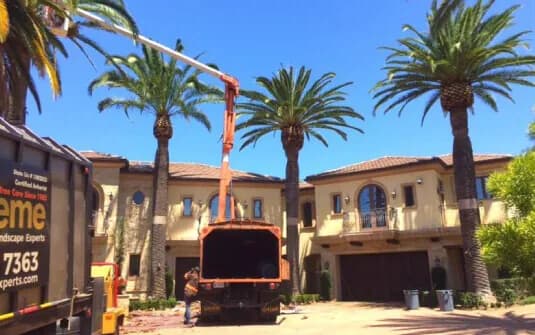
Lift truck access
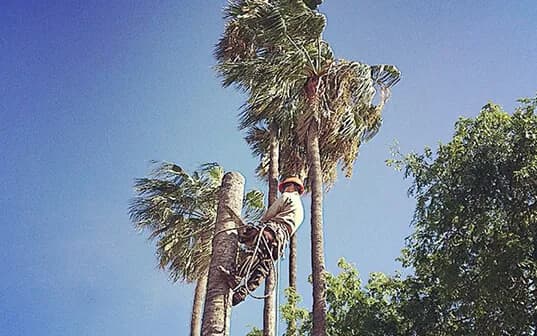
Worked from a bucket wherever one reaches, rather than climbed on spikes. A spiked palm carries those holes permanently, and each one is an entry point for the rot and disease that follow.
Sterilized blades, every palm
Fusarium wilt has no cure and moves between date palms on contaminated saws. Tools are cleaned between trees as a matter of routine, which is the one step that separates a trim from spreading a disease.
Why Supreme Tree Experts for palm tree trimming and skinning
We work palms from a lift truck wherever it reaches, never on spikes. Spike holes stay in a palm for life and let rot in. Blades are cleaned between palms, because Fusarium wilt spreads on dirty saws. There is no cure once a date palm has it.
Only dead fronds, flower stalks and seed pods come off. Green fronds above the horizontal stay, because they feed the palm. We never cut a palm back to a thin spike. Fronds and pods go straight into the truck, and the full clean-up is included.
ISA Certified Arborist
An ISA Certified Arborist oversees the work. The arborist names the palm, counts what needs to come off and checks whether the lift truck reaches it.
Licensed, Bonded & Insured
CA license #1002853 covers C-27 Landscaping and C-61/D-49 Tree Service. We are bonded, carry general liability, and every employee has workers' comp for work at palm height.
Southern California Since 1985
We have trimmed fan, queen and Canary Island date palms across Southern California since 1985. We set each cycle by species, not the calendar.
Our Own Equipment
Our own lift truck for palms reaches the crown without spikes. Our haulers take every frond and seed pod off the property.
How a palm trim runs
- 01.
Species and access checked
An arborist identifies the palm, counts what needs to come off and works out whether the lift truck reaches it or the crown has to be climbed.
- Free on-site visit
- Lift truck wherever it reaches
- 02.
Fronds, pods and boots
Dead fronds and spent stalks are cut at the petiole, seed pods come off before they drop, and boots are trimmed or left according to the species and the finish you want.
- Blades sterilized between palms
- Live crown left intact
- 03.
Hauled off the property
Fronds and pods go straight into the truck. A palm skirt on the ground is the messiest part of the job, and it does not stay there.
- Seed pods removed from site
- Full clean-up included
If you are going to trim a palm yourself
Plenty of palms are small enough to do from the ground, and there is no reason to pay somebody for a job you can safely do yourself. This is how to do it properly — and where to stop.
Only cut what is actually dead
Brown and dry fronds, spent flower stalks, and fruit or seed. A green frond above the horizontal is feeding the palm; taking it is not tidying, it is removing food. If you are unsure whether a frond is done, it is not done.
Sterilize the blades before you start
Brush the sawdust off them first, then soak for ten minutes — one part household bleach to one part water, or one part pine oil to three. Those are UC IPM's figures, and the brushing is the part people skip: a disinfectant cannot reach through packed sawdust. Fusarium wilt spreads on dirty saws and there is no cure once a date palm has it, and Southern California has enough Canary Island date palms for one careless saw to matter. Sharpen them too — a torn cut invites more trouble than a clean one.
Match the tool to the frond
A serrated knife handles petioles under an inch. Loppers or pruning shears take anything thicker, and a hand saw the thickest. A chainsaw on a ladder is where this stops being a garden job — if it needs one, it needs somebody else.
Leave the boots that resist
Loose frond bases pull away by hand. Ones that do not come easily are still attached to living tissue, and forcing them tears the trunk — which does not grow back, on any palm, ever.
Then leave it alone for a year
Over-trimming is the most common way a healthy palm gets damaged. Once or twice a year is the ceiling, and cutting back to a narrow spike exposes trunk tissue that spent its life shaded and starves the crown at the same time.
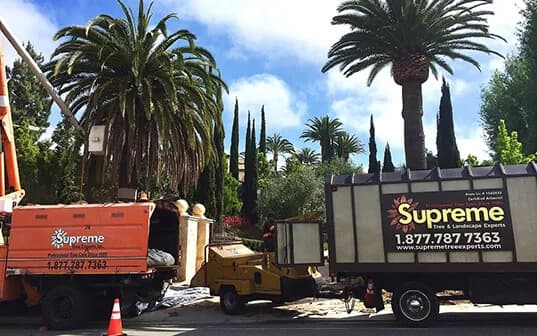
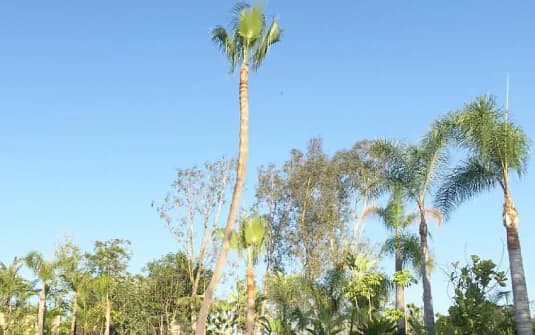
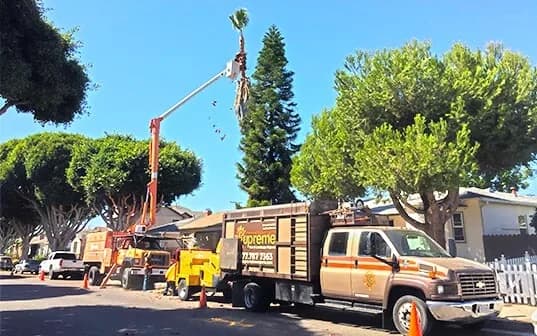
Where we work across Southern California
5 counties — Orange, Los Angeles, San Diego, Ventura and Santa Barbara — worked by crews running out of Santa Ana. These 7 areas are where most of it happens. Call 877-787-7363 if you are not sure whether your address falls inside them.
See every town we serveRecent palm tree trimming & skinning jobs
Real photos and videos from our own job sites. Tap any one to see it full size.
Real reviews, straight from our Google profile
Every word below was written by a customer on Google, not by us. Long reviews are shortened to fit the card — never reworded — and the full list is one click away.
“Great pricing & service. Highly competent with tricky jobs. We have used them for more than 10 years.”
Melanie Butler
Local Guide
“We got bids from five contractors. After I talked to them all and checked out their licenses and work, we decided to go with Supreme. … The job took a day and a half, and when they were done, they left the place immaculate.”
Hank Shaeffer
“Great tree trimmers! I’ve used Supreme Tree Experts twice to trim the palm trees in my yard. … The guys who come out are quick thorough, and clean. And very careful not to damage property.”
Emilie Pacheco
“These guys have worked on my property 3 times now. They are always on time and do a fantastic job. I highly recommend them!”
Ray Thompson
“After soliciting several quotes on some difficult yard work, we chose Supreme because of their licensed Arborist Temis … The crew was extremely hard working and we couldn’t believe their continuous work ethic on one of the hottest days of the year.”
Gary Brown
Local Guide
“Had them take out some tall eucalyptus trees on my lot in Hollywood. Great service. Fast, friendly and professional.”
Kirk Lee
Local Guide
Palm trimming questions from property owners
Frequency, season, browning fronds and over-trimming — six common questions that the sections above do not already answer. If yours is not here, call 877-787-7363 and ask.
Once a year suits most palm trees across Southern California. Twice is better over a pool, a driveway or a walkway, because with palms it is the falling fronds and fruit that cause the nuisance rather than the growth itself. More often than twice is where trimming starts costing the palm rather than helping it.
Both, and the safety half is the one that matters. A palm sheds dead fronds on its own schedule whether or not anybody is underneath, and a frond off a 40-foot crown carries real weight by the time it lands. Seed pods are heavier again. Left long enough, a loaded crown and a built-up skirt put enough weight on one side of the trunk to start a lean that does not straighten out.
Usually because that is what palms do — the oldest fronds die off from the bottom as the crown grows from the top, and a ring of brown below a full green crown is normal aging. What is not normal is browning that starts in the middle of the crown, or a spear leaf at the center that collapses or pulls out easily. That pattern points at disease or at the South American palm weevil, and it is worth an arborist looking rather than a trim.
Late spring, just ahead of the growing season, is the usual answer in this climate — but palms follow how the crown looks far more than the calendar, which is the one way they differ from every broadleaf tree on this site. Dead fronds and heavy seed can come off in any month. Deciduous dormancy rules simply do not apply.
Cutting a palm back to a narrow spike of upright fronds — and no. It looks tidy for a season and it is one of the most damaging things done to palms routinely. The fronds taken are the ones feeding the palm, the trunk narrows permanently at the point it was starved, and bark that spent its life shaded is left exposed. A palm cut that way never recovers the girth it lost.
Yes, and it is cheaper that way. Palm skinning is a separate service from palm trimming, but combining them means one lift-truck set-up instead of two, one crew visit and one quote.
On a short palm you can reach safely from the ground, yes. On anything needing a ladder, this is the wrong job to learn on — and the reason is the trunk rather than the height. A slip that cuts past the boot into trunk tissue leaves a scar the palm carries for the rest of its life, because palms cannot grow over a wound the way a broadleaf tree does. There is a step-by-step guide on our palm tree trimming page if you want to try the crown work first.
No — and it is the question worth putting to anyone who quotes. A palm has no bark and no cambium, so a spike hole never closes: it is in that trunk for the rest of the tree's life, and it is an entry point for trunk rot and an attractant for palm weevils. ANSI A300 bars climbing spurs for pruning and allows an exception only where the outer bark is thick enough to protect the inner bark and cambium — a test a palm can never pass, because it has neither. Everything a lift truck reaches is worked from the bucket; what it cannot reach is climbed on rope.
Any month, though spring and early summer are the easiest. Boots release more readily while the palm is in active growth, which means less cutting and less risk of tearing trunk tissue. In the mild Southern California winter there is no dormancy window to work around the way there is with broadleaf trees — this follows the palm's condition rather than the calendar.
Not when it stops at the dead frond bases — and genuinely, yes, when it does not. ANSI A300 defines the job as removing dead bases at the point they meet the trunk without damaging living tissue, and that is the entire line. Past it, the damage is permanent: a palm has no vascular cambium, so it cannot lay down new wood or close a wound the way a broadleaf tree does. UC IPM goes further on Phoenix palms, naming skinned and sculpted trunks among the risk factors for sudden crown drop and for Fusarium wilt entering through cut tissue. Conservatively done on a fan palm, this is routine work that fire authorities actively ask for. On a Canary Island date it is a judgement call every single time.
Years. A skinned trunk stays clean until new frond bases build back down it, and routine trimming of the crown slows that considerably — most palms need skinning once and then trimming on a normal cycle.
It removes where they were living, which is not the same as removing them. A dead frond skirt is a standard roof-rat nest site across Southern California, and taking it off means they have to go somewhere. If they are already into a roof space or an attic, that is a pest control job and a separate trade — what we can do is make sure the palm is no longer the way in.