Tree Shaping & Shrub Shearing in Santa Ana & Southern California
Based in Santa Ana, CA, we keep formal hedges, topiary and shaped ornamentals to a line across the five counties we cover — with selective pruning underneath, so the plant does not go hollow behind the face.
Tree Shaping & Shrub Shearing
Shrub shearing keeps the shape; pruning keeps the plant
Shrub shearing cuts across leaves and stems indiscriminately, and that is exactly what a formal shape needs. It also pushes growth to the outside. Every shear thickens the outer shell, the interior gets less light each season, and eventually a sheared hedge is a green skin over bare wood — which is why a cut back into one never grows back.
When shrub shearing is due, and when it is overdue
A formal shape only reads as deliberate while it is being held. The gap between due and overdue is short in this climate — and past a certain point the answer stops being a shear and becomes a decision.
The line has gone soft — a hedge face that was crisp in spring reading as fuzzy by midsummer is simply due, and a shear takes an hour
New growth has overtaken the shape — a topiary or a formal specimen whose outline you can no longer quite see is a season late rather than a year
It is into a path, a window or a driveway — hedges grow outward as well as up, and on a street frontage the encroachment is usually noticed from the inside first
Light has stopped reaching the bottom — a hedge wider at the top than the base shades its own lower half, and that half thins out and then gives up
There are bare patches that are not filling in — the signal that the shell has got too thick and the interior has been dark for too long
It has been years and it is now a row of small trees — at that point it is a renovation question rather than a maintenance one, and the species decides whether renovation is even possible
The rule that keeps a hedge alive: shear back into the current season's growth, not into old wood. Most of the damage done to hedges is done by someone cutting past that line in a single go.
Which hedges come back from a hard cut, and which never do
This is the one decision on the page that cannot be undone. A broadleaf plant usually carries latent buds along its old wood and can break out again from bare stems; most needled evergreens do not, and a cut behind the last living foliage leaves a bare stub that stays bare. Before anything gets cut back hard, the species decides the answer — not the budget, and not how bad it looks.
Privet and glossy privet
After a hard cut: Comes backThe safest renovation among the hedges common here. Georgia's extension service lists ligustrum among the broadleaf shrubs that respond well to renewal pruning, and it breaks freely from old wood once the light gets to it.
Oleander
After a hard cut: Comes backThe most forgiving plant on the list by a distance. Arizona's extension service says oleander can be cut completely to the ground every five to seven years — which makes an overgrown oleander screen a reset rather than a replacement.
Photinia
After a hard cut: Comes backSits on Mississippi State's list of broadleaf evergreens carrying latent buds along limbs, branches and trunk, which is the group that can be pruned drastically without killing the plant. Expect a season of looking worse before it looks better.
Yew
After a hard cut: Comes backThe one needled evergreen that genuinely does. UC's own conifer table marks Taxus as carrying latent buds on old wood and says plainly that it can be headed back into it — the exception that proves how the rest behave.
Pittosporum
After a hard cut: Comes back, in stagesOn the latent-bud list, so the plant survives it — but UC Marin's guidance is to take about a third of the tallest, oldest branches each year rather than cutting the whole thing to bare wood in one go. Three quiet years beats one dramatic one.
Boxwood
After a hard cut: Universities disagreeGenuinely unsettled, and worth knowing before somebody promises you otherwise. Mississippi State groups boxwood with the broadleaf evergreens that tolerate drastic pruning; Georgia says boxwoods recover slowly and may even die when severely pruned. On a boxwood the honest advice is to go gradually.
Arborvitae
After a hard cut: Universities disagreeA straight conflict between land-grant sources. UC's conifer table puts Thuja in the no-latent-buds column with the instruction not to cut below the foliage; Maryland names arborvitae among the few conifers that will respond to severe pruning. Nobody should be confident here, and we are not.
Juniper
After a hard cut: Universities disagreeUC records Juniperus as having some latent buds, with some forms headable into old wood. Georgia's line is never to take more than half the foliage. The practical reading: a juniper may come back, and planning on it is a gamble with no way back.
Podocarpus
After a hard cut: Stays bareCommon as a screen here, and unforgiving. UC's table records no latent buds on old wood and the instruction is exact: do not cut behind the last remaining needles. Past that line the stem is finished, permanently.
Italian cypress and the true cypresses
After a hard cut: Stays bareUC's instruction for Cupressus is exact, and it is not to cut below the foliage at all. The brown interior of a cypress has no growing points left in it, so a hedge cut back into that interior does not recover — it is a removal and a replant, and it is better to know that first.
Two things worth holding on to. The limit people quote — take no more than a third at once — is university extension guidance, from UC among others, and not a figure any standard imposes: the pruning standard's own 25 percent was advisory, and the current revision removed every numeric limit in favor of taking no more living material than the objective actually needs. And where a hedge genuinely has to come down a long way, UC's guidance for renovation is 20 to 30 percent of the overall growth a year until it reaches the height and shape you want — two or three seasons, one side at a time. UC is also candid about the alternative, and so are we: on a badly overgrown evergreen hedge it is sometimes cheaper and quicker to replace it than to rejuvenate it, and an honest answer on the day costs us the bigger job.
How tall can a hedge be in Santa Ana, our home city?
Three feet in a front yard on an ordinary street, four on an arterial — and no limit at all behind the house. The city writes hedges their own rule rather than folding them in with fences, which is why the eight-foot figure people quote at each other is the wrong number for a hedge. The rules below are the whole of it.
| Where the hedge is | What the code actually says | Height capped? |
|---|---|---|
| Front yard, on an arterial street | Four feet. SAMC 41-609.5 caps a hedge in the required front yard at four feet where the general plan's circulation element designates the street as arterial | Capped |
| Front yard, on any other street | Three feet — the same section, and the figure that catches most residential frontages in the city | Capped |
| Inside a street-corner triangle | Two and a half feet above the sidewalk, within a triangle running 25 feet back along each property line. SAMC 36-45 names hedges, shrubbery and natural growth outright, and makes it three feet above the intersection where there is no sidewalk | Capped |
| A side yard or a back garden | Nothing. The eight-foot cap everyone quotes is SAMC 41-610, which governs built fences and walls — its own material list is wood, wrought iron, stone, brick, stucco and block, none of which a shrub can be | No limit |
| A short run of shrubs across part of the frontage | Also nothing. The code defines a hedge as a dense row covering at least half a parcel's linear frontage, so a shorter run is not a hedge for the purposes of the front yard rule | No limit |
| A hedge blocking a neighbor's view | The city has no view ordinance. No view preservation, no view restoration, no spite-fence provision — nothing in the code gives a neighbor a claim against your planting for blocking an outlook | No limit |
Section numbers are from our home city's Municipal Code (SAMC), as the City publishes it. Heights are measured as each section states, and a hedge on a designated setback street has its own four-foot rule at SAMC 41-698. Other cities set their own hedge rules, so check with yours.
Two practical things the table cannot hold. First, planting or trimming a hedge needs no permit under this code — the front yard permit at 41-610(b) is for a constructed fence over eighteen inches and does not reach plant material — but a hedge along a street line does carry a duty: under SAMC 10-71 the owner has ten days from a written notice by the director of public works to cut it back so it neither injuriously shades the sidewalk nor overhangs the inner edge of it. Second, the only branch-clearance height in the code that attaches to a private owner is the corner exemption at 36-46, which wants trees trimmed clear to seven feet above the sidewalk — the fourteen-foot figure belongs to the City's own street trees and not to yours. Properties in French Park sit outside all of this: the hedge and fence sections both exclude SD No. 19 and refer it to its own district standards. This is general information about the code rather than planning advice, and your own city's planning counter answers for your address.
How much does tree shaping and shrub shearing cost?
The length of hedge or the number of plants, how far past due it is, and the $600 tree-services minimum underneath all of it. Shearing a hedge on schedule is quick work. The same hedge after three seasons is a different job, because there is far more material to cut and far more to take away.
The 6 things tree shaping and shrub shearing is priced on
How much there is
Linear feet of hedge, or the number of individual shrubs and shaped specimens on the property. It is the first number to have ready when you call, and it gets a quote closer than any description will.
Height, and whether it needs a platform
Anything worked from the ground is straightforward. A hedge above head height needs a platform or a lift, which changes the crew and the day rather than just the time.
How long since the last cut
A hedge on schedule is trimmed back into this year's growth. One that has run for three seasons has to be brought back in stages, or renovated — both of which cost more than three ordinary visits would have.
Sheared or shaped by hand
A hedge face takes a shearing head. A topiary, a cloud form or an ornamental specimen is cut by hand, branch by branch, and that is slow work priced accordingly.
Species and growth rate
Ficus microcarpa puts on enough growth between visits to lose its line entirely, and it is the commonest large hedge here by a distance; a slower species holds a shape for far longer. The same hedge in two species is two different annual costs.
Volume of clippings
Shrub shearing generates a remarkable amount of fine material for the size of the plant. Collection and haulage is included; the volume still shows up in the day.
Regular shrub shearing is the one service on this site where frequency genuinely lowers the annual cost rather than raising it. Three scheduled visits across a year beat one rescue, and the rescue is the visit that cannot promise the hedge comes back.
Hedges, screens, topiary and ornamental shaping
These are six separate crafts sharing a page. A shearing head and a pair of hand secateurs are not interchangeable, and knowing which one a plant in front of you needs is most of the job.
Book a free assessmentFormal hedges
A flat face and a level top held to an agreed line. Cut with a batter — wider at the base than the top — so light reaches the bottom of the hedge instead of only the crown, which is what stops the lower half thinning out. Maryland's extension service puts numbers on it: a five-foot hedge wants roughly three and a half to four feet across the base and about a foot across the top. No university publishes an angle for it, so anyone quoting you degrees is quoting themselves.
Boundary and privacy screens
Taller and less formal, kept dense rather than crisp. A screen only works while it is thick, so on a boundary the shearing schedule is doing a job rather than just tidying.
Topiary and shaped specimens
Balls, cones, cloud forms and anything with a silhouette worth keeping. Cut by hand against the form rather than run over with a machine, because a shearing head cannot see the shape it is cutting.
Ornamental tree shaping
Working with a tree's own habit rather than imposing a face on it — the client's own term for this is artistic shaping, and it is closer to pruning than to shearing.
Hedge renovation
Bringing an overgrown hedge back, usually one side per year over two or three seasons. Whether it can be done at all is decided by the species, not by the budget — see the questions below before committing to it.
Selective pruning underneath
Windows cut into the sheared shell so light reaches interior wood. The one operation that keeps a sheared plant recoverable rather than turning it into a green skin over bare stems.
Why Supreme Tree Experts for tree shaping and shrub shearing
Shearing holds a shape, but it thickens the outer shell each season. Behind it, the inside goes dark and bare. So we also cut small windows into the shell to let light reach the inner wood. That keeps a sheared hedge able to recover.
Before any cut, we agree the height and face you want held. We tell you plainly where a hedge has gone hollow and how much can come back. Ornamental trees are shaped by hand, cut by cut. Clippings are collected, not blown into the beds.

ISA Certified Arborist
Work runs under an ISA Certified Arborist. The arborist knows which species come back from a hard cut and which stay bare for good.
Licensed, Bonded & Insured
CA license #1002853 covers C-27 Landscaping and C-61/D-49 Tree Service. We are bonded, carry general liability, and every employee has workers' comp for work on tall hedges.
Southern California Since 1985
We have shaped hedges across Southern California since 1985. We know how fast a ficus hedge loses its line between visits in this climate.
Our Own Equipment
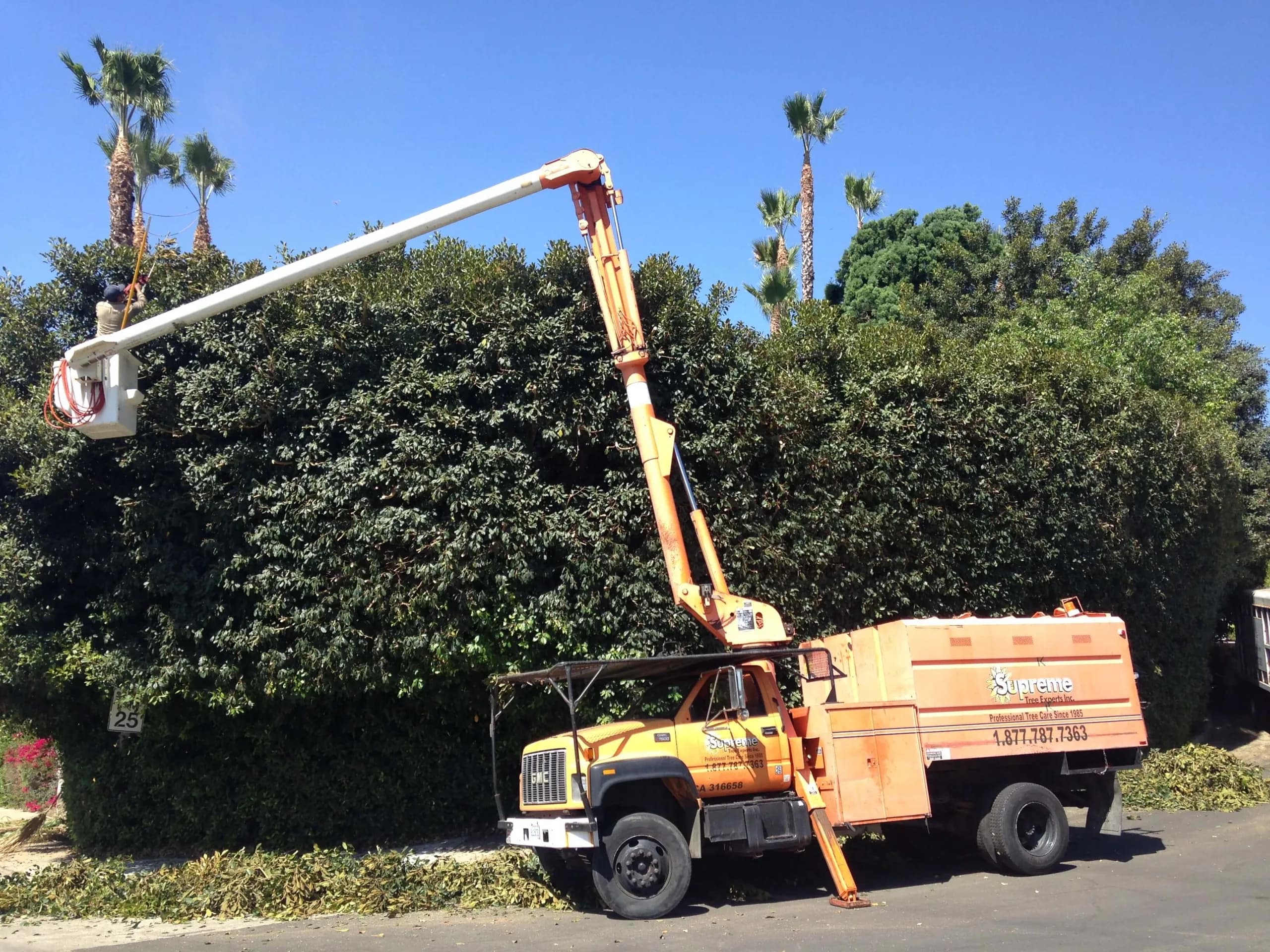
Our own 75-ft boom trucks reach hedges well above head height. Our haulers take away the heavy volume of clippings that shearing makes.
How tree shaping and shrub shearing is done
- 01.
The line agreed first
Someone drives out, looks at the plants, agrees the height and face you want held, and says plainly where a hedge has already gone hollow and how much of it can be recovered.
- Free on-site visit
- Told what will not grow back
- 02.
Sheared, or shaped by hand
Hedges and formal shapes are sheared to the agreed line. Ornamental trees are shaped by hand, cut by cut, rather than run over with a shearing head.
- Consistent face and height
- Ornamentals shaped by hand
- 03.
Opened up and collected
Selective cuts are made into the shell where light needs to reach the interior, and the clippings are collected rather than blown into the beds.
- Interior opened to light
- Clippings collected, not blown
Where we work across Southern California
5 counties — Orange, Los Angeles, San Diego, Ventura and Santa Barbara — worked by crews running out of Santa Ana. These 7 areas are where most of it happens. Call 877-787-7363 if you are not sure whether your address falls inside them.
See every town we serveRecent tree shaping & shrub shearing jobs
Real photos and videos from our own job sites. Tap any one to see it full size.
Real reviews, straight from our Google profile
Every word below was written by a customer on Google, not by us. Long reviews are shortened to fit the card — never reworded — and the full list is one click away.
“Great pricing & service. Highly competent with tricky jobs. We have used them for more than 10 years.”
Melanie Butler
Local Guide
“We got bids from five contractors. After I talked to them all and checked out their licenses and work, we decided to go with Supreme. … The job took a day and a half, and when they were done, they left the place immaculate.”
Hank Shaeffer
“Great tree trimmers! I’ve used Supreme Tree Experts twice to trim the palm trees in my yard. … The guys who come out are quick thorough, and clean. And very careful not to damage property.”
Emilie Pacheco
“These guys have worked on my property 3 times now. They are always on time and do a fantastic job. I highly recommend them!”
Ray Thompson
“After soliciting several quotes on some difficult yard work, we chose Supreme because of their licensed Arborist Temis … The crew was extremely hard working and we couldn’t believe their continuous work ethic on one of the hottest days of the year.”
Gary Brown
Local Guide
“Had them take out some tall eucalyptus trees on my lot in Hollywood. Great service. Fast, friendly and professional.”
Kirk Lee
Local Guide
Tree shaping and shrub shearing questions
Bringing an overgrown hedge back, which species suit shearing, timing, and shared properties — six the sections above do not already answer. If yours is not here, call 877-787-7363 and ask.
No, and California is stricter here than the federal rule rather than looser. Fish and Game Code 3503 makes it unlawful to take, possess or needlessly destroy the nest or eggs of any bird — not only a migratory one — and 3503.5 covers hawks and owls with the word needlessly left out altogether, so a raptor nest is protected outright. The federal Migratory Bird Treaty Act names the nest inside its own prohibition. What does not exist is a legal calendar: CDFW abandoned the rulemaking that would have set one, and its advice is that nesting season runs roughly February through August for many California species while warning that timing varies by species and location and that some birds nest year-round. Firmer dates you may be quoted come from individual project permits, not from a statewide rule. On any hedge the practical answer is that somebody looks before anybody cuts, and an active nest moves the visit rather than changing the method.
Dense, small-leaved plants — boxwood, privet, ficus and similar hedging. Large-leaved shrubs sheared flat end up with cut leaves browning along every edge, which is why a sheared laurel looks worse two weeks later than it did on the day.
Through the growing season, with the last cut late enough that the shape holds into winter. A formal face generally wants three to five shears across a growing season — that is Georgia extension's figure for formal hedges, and a long Southern California season on a fast species sits at the top of it rather than the bottom. UC's rule of thumb is simpler and more useful on site: shear before the new growth gets past a foot, and earlier than that on a slow plant like boxwood where the crispness is the whole point. A hard renovation cut is a different job on a different date — late winter, before growth begins, so the plant has an entire season in front of it to answer.
Yes. Say at the estimate what the shape is meant to be — an established form is far easier to keep than to guess at, particularly on a hedge that has been let go for a season or two and needs bringing back in stages.
Yes, and it costs less that way. The crew, the chipper and the clean-up are already on site, so tree shaping and shrub shearing quoted alongside tree trimming and pruning avoids paying for a second trip.
Yes — estates, condominiums, homeowner associations, business parks, plazas, retail centers and school grounds, alongside ordinary residential gardens. Shared and managed properties usually want the hedges and screens on a set rotation rather than booked each time, which is scheduled the same way tree maintenance is.