
Stump Grinding & Stump Removal in Santa Ana & Southern California
Two different jobs on one page. Across Southern California, from our base in Santa Ana, CA, stump grinding takes the stump 6–12 inches below grade and leaves the roots to break down; full removal pulls the root ball out whole. The on-site estimate costs nothing.
Stumps
Stump grinding or full removal?
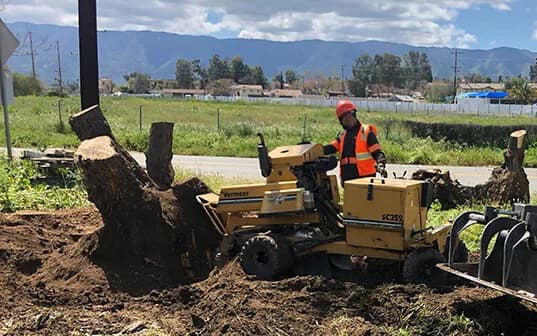
Stump grinding, in almost every case. The cutting wheel takes the stump to 6–12 inches below grade, the hole is backfilled and the ground is usable the same day. Full removal — pulling the root ball out whole — is the right answer only when something is going in that exact spot: a footing, a pool shell, a retaining wall, or a replacement tree that needs the room.
Why a stump should not just be left there
A cut stump looks finished. It is not. It is several hundred pounds of dying wood sitting at ankle height in the middle of a lawn, and every one of these six gets worse rather than better with time.
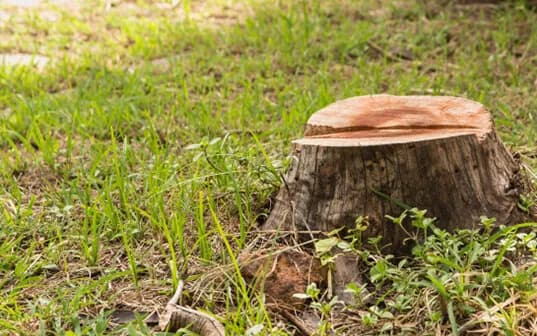
It is a trip hazard at exactly the wrong height — low enough to disappear in grass, solid enough to break a toe or a mower blade
It wrecks lawn equipment — a mower deck or a string trimmer finds a hidden stump once, and the repair usually costs more than the grind would have
It feeds pests and fungi — carpenter ants, termites and wood-boring beetles colonise dying wood, and Armillaria mellea, the honey fungus, moves through the root system to the trees still standing
It sprouts — some species push a ring of suckers around the cut and keep doing it, so you end up mowing a thicket where one tree used to be
It blocks the ground for years — nothing can be planted, paved or built over a stump, and the roots stay in the way long after the top is gone
It reads as neglect from the street — a stump in a front lawn is the one piece of landscaping everybody notices and nobody credits you for
None of this is urgent the way a leaning tree is. All of it costs more the longer it waits: a stump left through one dry summer grinds harder than a fresh one, and the roots spread what is living in it while you decide.
What grinding a stump actually gets you
Grinding is the cheaper of the two jobs and the right one nearly every time. What it buys is not only a tidy lawn — it is the end of the thing the pests were living in and the end of the regrowth.
Nothing left to colonise
A ground stump stops being habitat, and the pests living in dying heartwood lose what they were living in — which matters most where other trees stand nearby. Be straight about the limit, though: Armillaria mellea survives for decades in the residual roots a grinder leaves behind, so on a tree that died of honey fungus, grinding reduces the inoculum rather than ending it.
No regrowth to keep cutting
Grinding takes out the root collar, which is where a stump sprouts from. Left alone, a liquidambar or an elm stump will push suckers for years and each one has to be cut again.
Ground you can use again
Six to twelve inches below grade is enough to lay turf, run irrigation or plant over. Deeper is possible where a footing, a path or a replacement tree is going in the same spot.
Mulch you already own
The grindings come out as wood chips. They go back into the hole, or onto a path or a bed where nitrogen tie-up is not an issue — which is free material most people pay for by the bag.
One visit, not a project
A grinder does in an hour or two what digging out a root ball takes a machine and most of a day to do, and it leaves the lawn around it largely intact rather than opening a crater across it — which on a finished front yard is the whole difference between a visit and a project.
What sits at grinding depth in a yard
Two working days' notice to 811 before a wheel turns, and the call is the contractor's job rather than yours. Government Code 4216 defines excavation as any operation that moves or displaces earth by means of equipment, with no depth threshold attached, so a stump grind is excavation. Section 4216.8 exempts a homeowner who hires a licensed contractor for permit-free work on their own property — it does not exempt the contractor. What the free locate covers, and what it quietly does not, is what decides whether the job goes well.
| What is buried down there | How deep it usually sits | Marked by 811? |
|---|---|---|
| Gas service line to the house | At least 12 inches of cover on private property — 49 CFR 192.361 | Marked |
| Electric service and buried branch circuits | 12 inches for a GFCI-protected 120-volt run, 24 inches direct burial | Marked |
| Cable, phone and fibre drops | No enforceable minimum — a drop is often shallower than the wheel | Marked |
| Low-voltage landscape lighting | 6 inches under NEC Table 300.5, which is above any grinding depth | Not marked |
| Irrigation lines and the valve manifold | No California code sets one; practice runs 8 to 18 inches | Not marked |
| Sewer and storm drains that are not pressurised | Excluded from the definition of a subsurface installation by Government Code 4216(s) | Not marked |
DigAlert marks what the utilities own, and that usually stops at the meter. Anything a previous owner buried past it — the feed to a detached garage, the line to a pool heater, the irrigation, the lighting — is a private locate, and finding it falls to the property owner. Government Code 4216.4 then keeps power equipment out of the 24-inch tolerance zone either side of a mark until the line has been exposed by hand, which is how a stump sitting six inches off a gas mark turns into a dig rather than a grind. A ticket lasts 28 days; the paint lasts only as long as it stays readable.
How much does stump grinding cost?
Stump work starts at the $600 tree-services minimum, and above that floor diameter does most of the work. Grinding is priced on how much wood the wheel has to go through and how easily the machine reaches it, which is why a quote comes after somebody has seen the stump rather than over the phone.
The 7 things a stump grind is priced on
Diameter across the cut
The single biggest factor. A 12-inch stump and a 36-inch stump are not three times apart in work — the wheel has roughly nine times the area to clear, and it has to do it in passes.
How many stumps there are
Each one after the first is cheaper than the first. The machine and the crew only travel and set up once, so four stumps on one visit cost far less than four separate bookings.
How the machine reaches it
Gate widths and side access decide which grinder comes out — a back-yard stump reached through a side gate needs a different machine from one sitting on a driveway. On block-walled tract lots that is most of them, and where no machine fits at all the work slows down considerably.
What is around and under it
What is under a stump changes the method before it changes the risk. A marked line inside the tolerance zone has to be exposed by hand before the wheel goes anywhere near it, and hand-digging is time on the job rather than a line on the invoice — which is why the locate happens before the quote is firm.
Species and how long it has stood
Dense hardwoods grind slower than softwoods, and a stump that has stood long enough to dry out is harder work than a fresh one. Waiting does not make this cheaper.
Soil and grit
Sandy or rocky ground blunts a cutting wheel fast, and a stump that has settled with soil packed into the root flare grinds through dirt as well as wood. Teeth are a real running cost on this equipment.
How you want it left
Backfilled with the grindings costs nothing extra. Hauling the grindings away and bringing in clean fill or topsoil is a truck movement, and it belongs in the quote rather than on the invoice.
Full extraction — pulling the root ball out whole — is priced separately and is always more, because it moves ground rather than wood.
The 6 stump services we run
What is going into the ground afterward decides which one you need. Grinding and full removal answer the same question with different machines and different prices, which is why both live on one page rather than two.
Book a free assessmentStandard stump grinding
The cutting wheel takes the stump to 6–12 inches below grade and the hole is backfilled with the grindings. Enough for turf, irrigation or ordinary planting over the top, and the ground is usable the same day.
Deep stump grinding
Further down, where a replacement tree or paving is going in the same spot — how deep is decided by what is going over it rather than by a standard depth. For a slab or a footing, depth is the wrong question entirely: the California Residential Code requires all vegetation and foreign material out of the area within the foundation walls, and fill free of vegetation. That is extraction, not grinding, at any depth.
Full stump removal
The root ball dug and pulled out whole, leaving no wood in the ground at all. More expensive and far more disruptive — it opens a crater the width of the root plate, with fill and compaction to sort out afterward.
Surface root grinding
The roots running across a lawn or lifting a path, taken down below grade separately from the stump itself. How much can safely come off depends on whether the tree above them is staying.
Multiple stumps and lot clearing
Priced per visit rather than per stump once there are several, because the machine, the crew and the travel are the same whether it grinds one stump or nine. Worth batching rather than calling twice.
Backfill and finish
Grindings back in the hole as standard, or hauled away and replaced with clean fill where turf or planting is going straight over. The nitrogen point is half a myth: grindings spread as a surface mulch starve nothing, because the depleted layer is about half an inch at the interface. Grindings mixed into the backfill genuinely do tie nitrogen up while they break down, and that is exactly what happens by default when a grinder fills its own hole.
Why Supreme Tree Experts for stump grinding and removal
Grinding is the right answer in almost every case. The wheel takes the stump 6 to 12 inches below grade. The hole is backfilled with the grindings, so the ground is usable the same day. Full removal pulls out the root ball. It only makes sense when a footing, wall or new tree needs that exact spot.
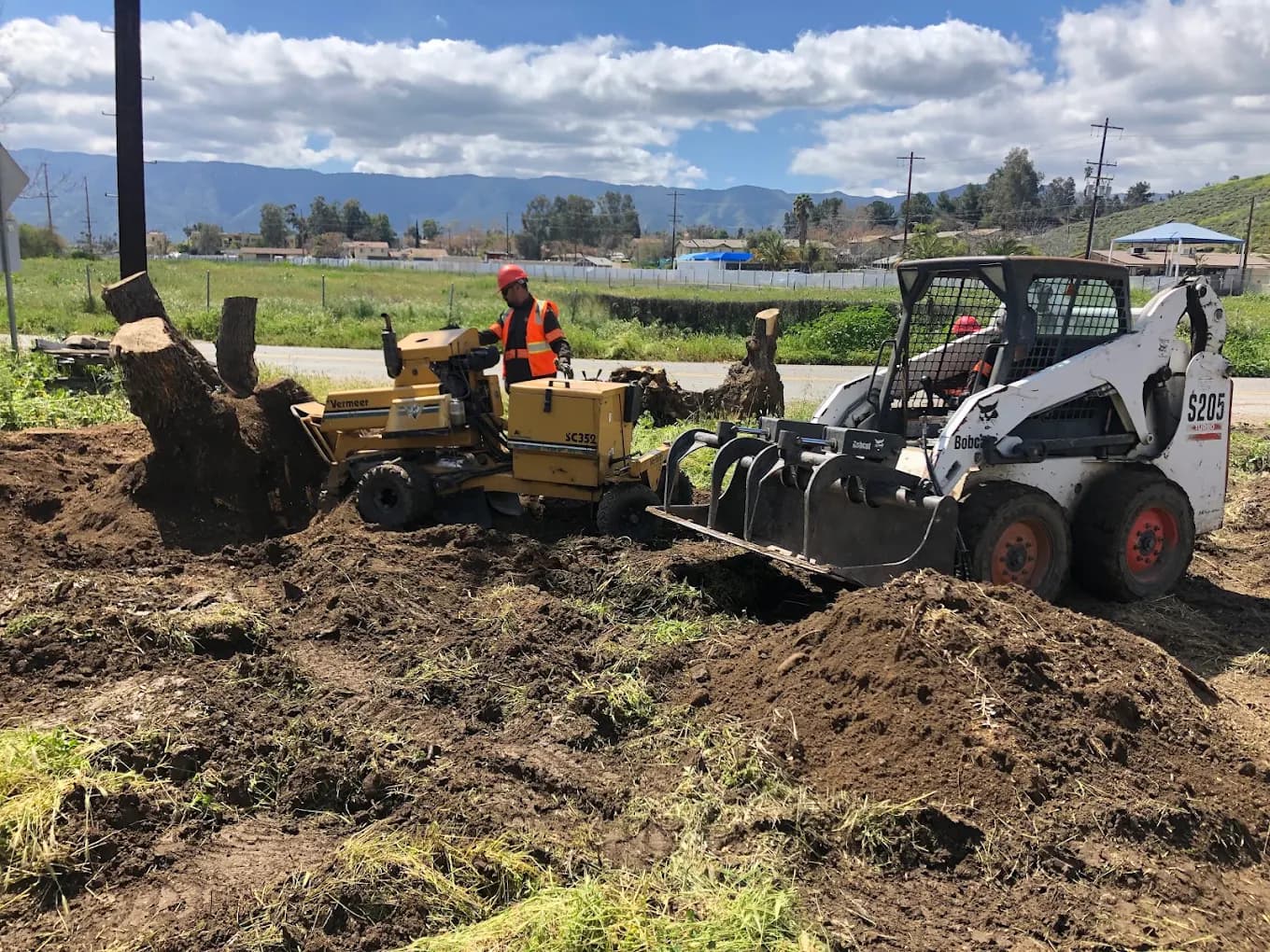
Before the wheel turns, we send the 811 notice at least two working days ahead. We check the irrigation and work out how the machine reaches the stump. Gate width decides which grinder comes out. When the grind is done, the area around the hole is raked down.
ISA Certified Arborist
The work runs under an ISA Certified Arborist. The arborist judges how much surface root can come out safely when the tree above is staying.
Licensed, Bonded & Insured
CA license #1002853 covers C-27 Landscaping and C-61/D-49 Tree Service. We are bonded, carry general liability, and every employee has workers' comp for grinding near buried lines.
Southern California Since 1985
We have ground out stumps across Southern California since 1985. We know a stump left through a dry summer grinds harder than a fresh one.
Our Own Equipment
Our own stump grinders come in more than one size, so a narrow side gate is not a dead end. Our haulers take the grindings away on request.
How a stump comes out, start to finish
- 01.
Located before anything cuts
The work area is marked out, the 811 notice goes in at least two working days ahead, irrigation is checked, and the crew works out how the machine reaches the stump — gate widths and side access decide which grinder comes out.
- 811 utility locate first
- Access checked before scheduling
- 02.
Ground below grade
The cutting wheel takes the stump down 6–12 inches below grade, and deeper where turf, paving or new planting is going in over the top.
- 6–12 inches below grade
- Deeper where planting follows
- 03.
Backfilled and raked
The hole is backfilled with the grindings, or cleared out entirely if you would rather bring in clean fill, and the surrounding area is raked down.
- Hole backfilled the same visit
- Grindings hauled on request
Where we work across Southern California
5 counties — Orange, Los Angeles, San Diego, Ventura and Santa Barbara — worked by crews running out of Santa Ana. These 7 areas are where most of it happens. Call 877-787-7363 if you are not sure whether your address falls inside them.
See every town we serveRecent stump grinding & stump removal jobs
Real photos and videos from our own job sites. Tap any one to see it full size.
Real reviews, straight from our Google profile
Every word below was written by a customer on Google, not by us. Long reviews are shortened to fit the card — never reworded — and the full list is one click away.
“Great pricing & service. Highly competent with tricky jobs. We have used them for more than 10 years.”
Melanie Butler
Local Guide
“We got bids from five contractors. After I talked to them all and checked out their licenses and work, we decided to go with Supreme. … The job took a day and a half, and when they were done, they left the place immaculate.”
Hank Shaeffer
“Great tree trimmers! I’ve used Supreme Tree Experts twice to trim the palm trees in my yard. … The guys who come out are quick thorough, and clean. And very careful not to damage property.”
Emilie Pacheco
“These guys have worked on my property 3 times now. They are always on time and do a fantastic job. I highly recommend them!”
Ray Thompson
“After soliciting several quotes on some difficult yard work, we chose Supreme because of their licensed Arborist Temis … The crew was extremely hard working and we couldn’t believe their continuous work ethic on one of the hottest days of the year.”
Gary Brown
Local Guide
“Had them take out some tall eucalyptus trees on my lot in Hollywood. Great service. Fast, friendly and professional.”
Kirk Lee
Local Guide
Stump grinding questions from property owners
Doing it yourself, hire machines, what the roots do afterward and how long the ground takes to settle — six questions from property owners that the sections above do not already cover. If yours is not here, call 877-787-7363 and ask.
A small one, with patience. Anything over about a foot across, realistically no. A rental grinder from a home improvement store is a walk-behind machine sized for garden stumps — it will work through a small one slowly and stall on a large one, and by the time you have paid the day rate, collected it, fought it and returned it, the gap to a professional grind has closed considerably. The other half nobody mentions: a rented machine comes with no insurance for what it hits, and irrigation, cable and gas services all sit at stump-grinding depth.
Yes, but not straight into the grindings and not in the exact same spot by default. Wood chips tie up nitrogen as they decay, so a sapling planted into them starves. For replanting, the stump is ground deeper, the grindings come out, and clean soil goes back in. Planting a few feet to one side is easier on the new tree, and planting a different species avoids inheriting whatever root pathogen took the last one.
The grinder leaves tracks across a lawn and that is the honest answer. Rubber-tracked machines and boards where the ground is soft keep it to marks that recover rather than ruts that do not. A debris shield goes up before the wheel turns, because a grinder throws chips and grit hard enough to chip paint and crack glass — that is what the shield and the crew positioning are for.
Several months, and it will drop. Backfilled grindings sit loose and then compact as they break down, so a hole that was level on the day often becomes a dip by the following season. Heap the backfill slightly proud of grade rather than flat, and expect to top it up once. Turf laid immediately over fresh grindings will show the same dip through it.
Usually, down to about a 36-inch gate. Grinder size is chosen for the access, which is the whole question on older lots where a side gate is the only route to the back yard, so the useful thing to tell us when you call is the width of the narrowest gap between the street and the tree stump. That one measurement decides which machine comes out.
Yes. A seasoned hardwood stump takes longer than a fresh softwood one and dulls teeth faster, which shows in the quote — but neither changes whether the job gets done.